
With residencies at Vitalstatistix in April and May, two projects now in development address questions of labour and pleasure, embodiment, sex work, and online/IRL interactions.
The Read is a collaboration between dancer and choreographer Amrita Hepi and writer, sex worker and activist Tilly Lawless, investigating labour, desire, and bodies and their mechanics, drawing on Amrita’s interests in participatory research, intimate conversations and resilience.
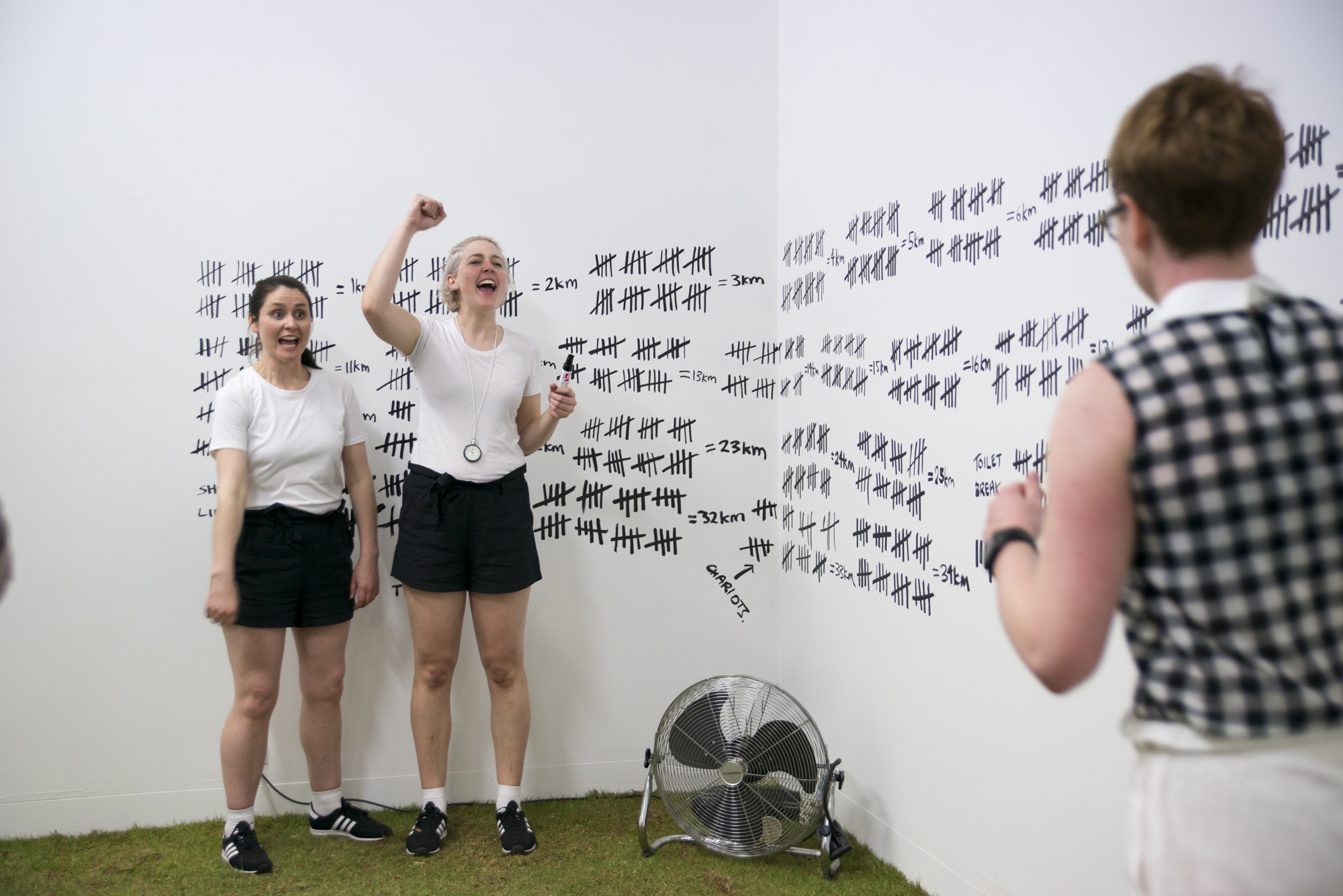
Artists amira.h. and Monte Masi are collaborating on Goddess Ball’s Fun House, using text, performance and endurance to explore the online world of adult camming sites, the nature of work and play, and the true meaning of fun.
Jennifer Mills spoke with both these creative duos over Zoom about their works in progress, collaborative practices, friendship and trust, labour and time, adaptation, pleasure, and making meaningful work.
JM Starting with amira and Monte. Where did the idea spring from to work together?
Monte Masi amira’s and my relationship goes back a fair while, we both studied at the South Australian School of Art at around the same time, but this project is our first time directly collaborating. The first development was part of last year’s Adhocracy at Vitalstatistix and because of “the situation” (laughs), amira and I spent the Adhocracy weekend in 2021 working at a distance over Zoom.
This project really begins with you, amira, sharing an artist’s book – a piece of collected text that you had been amassing, which was text from camming sites’ chat rooms. amira eventually sent me a 2,000 page pdf of that which went by the same name, ‘Goddess Ball’s Fun House.’ And amira had mentioned sharing that text amongst a few people and inviting a response, so whoever had the honour of receiving the text might become obligated to create a response.
amira.h. The text was collected from October 2018 to 2020 sometime, but then I went back and got more, which I haven’t actually added to the ibook file I sent you… it’s not a pdf, it is specific because the pdf has lots of emojis and they don’t move but I wanted people to see what I was seeing on the sites, which is a lot of emojis, emoticons I call them, and they’re very different from other social media, very specific to these sites. So yep, it was a 2,000 or so page ibook.
JM That’s a weighty tome! Why did you start collecting this document?
a.h. Well, that’s what I do – I collect stuff, even at uni I would give people postcards and tell them to text me a response and then I created a book – I called it a book – of pages stuck on the wall, of people’s responses to me. That was in the hundreds, just text responses. I like collecting things.
JM It sounds like a very zine-influenced practice to me.
a.h. I do love zines, definitely.
MM You were going to curate an exhibition based on these responses.
a.h. That was Dominic Guerrera’s idea, he works at Country Arts, and he suggested we could show it at Nexus, but that just didn’t feel right. So then Monte asked me to be an assistant to a whole other project, and I was living on Kaurna land, in Adelaide, but now I’m not, so I had moved and Monte asked if I could still assist and I said I didn’t know, and then he said Vitals have this Adhocracy thing due tomorrow, let’s just quickly write up a proposal (laughs).
MM I saw us putting together the Adhocracy application as a continuation of your invitation to think of a response to that text. I thought we could create that response together.
JM I love that Adhocracy is a space that you can jump on at those moments. It sounds like this project has been through a few versions of itself, are you still taking a digital/online approach?
a.h. It is definitely morphing. Recently Monte said ‘I don’t want to have Zooms or livestreams in our work!’ We want it to be in real life, IRL.
JM There was a lot of excitement around the potential of online spaces but now there’s so much fatigue as well, people are really happy to be able to be physically with each other again.
a.h. It’s true. In my head I kind of see a live chat, you know, I definitely wouldn’t want to show any of the people on the websites, so I want to be able to zone in on the chat and have that accessible in the space, and that might be the only online component.
MM I am certainly cognisant of that snap-back to the way things were. It was great to have a lot of stuff over Zoom and suddenly people being quite invested in livestream, even for me as someone who thinks of themselves as able-bodied or reasonably mobile, it was a treat to be able to for example catch something in New York that you wouldn’t have seen otherwise, let alone how it might have felt for someone who actually finds it incredibly difficult to get into a theatre or a performance space. But I think maybe it’s because the first time we really had a development for this work we had to do it over the screen, I just think a lot of the ideas and a lot of the forms that we’re imagining and dreaming of for this work are things that you do in front of other people.
JM Are you going to retain a participatory element of that, with people whose conversation you’re using as source material?
a.h. I have got some ideas, but Monte and I haven’t decided on anything concrete yet.
JM In terms of working out those kind of mechanisms or ideas, what’s your process as a collaboration?
a.h. We try to have Zoom meetings every 2-3 weeks. I text Monte all the time, probably annoyingly, if I get an idea I just send it to him, it’s very spontaneous for me and that’s what I like about it.
MM In some ways it has been fairly spontaneous but it’s also been quite discursive, in that sometimes we will have what is ostensibly a meeting which will end up with you, amira, telling me particular details of a particular period in your life or a particular kind of online web of intrigue, and going down a sort of rabbithole of different things, and trusting to do that while not knowing whether it really lives in the world of the work.
JM While we’re talking about these blurring boundaries I’m going to let Amrita and Tilly into the meeting. We’ve just been talking about collaboration and the way that art and life blend a little in the process. Amrita and Tilly were you friends before you started this project together?
Tilly Lawless We knew each other vaguely but we have definitely become closer through doing it.
Amrita Hepi Tilly made a really good point today, that because this has been so delayed it’s been a nice way to get to know each other. If we had started 2.5 years ago when we were originally supposed to start, maybe it would have been harder. I feel like there was material generated in speaking to each other and getting to know each other.
We had this conversation about the kind of economy that the arts runs on, the economy of friendship, that obviously there is a camaraderie, and it’s one of the most beautiful things, but that it can also be really abusive in some ways.
JM Totally. It can manifest as exploitative labour practices very quickly.
TL There is a level of trust that has come with knowing each other for the last few years that makes me feel like I can trust what Amrita says in the room.
I think that if we’d started not knowing each other well that I would have been quite tentative, and I don’t feel that. I feel quite confident in voicing my opinion. I only see the friendship as positive. I understand that people can exploit friendships in order to get certain artistic things from people or to not pay people for their labour but I haven’t felt like that one bit.
AH I said to Tilly at the start that sometimes there can be a tyranny of structurelessness: we’re improvising, we’re trying things, the hierarchies are different, and in the room I am performing in it too, I’m in it with you. But I am the director. I will be making the work. And I think there is a nice trust that comes from knowing that is your responsibility.
JM It builds trust when there’s a bit of clarity around roles.
TL A director is the same role you would get when, as a writer, you have an editor editing your work. You have someone that has more power than you, you’ve agreed to them having a say over what you’re doing, and you trust them in the critiques that they’re going to give… I wouldn’t say yes to being directed by someone unless I respected that they could direct me well.
JM I wanted to ask all four of you a bit more about process as labour but also process as play, and where that sits for you as a collaboration and how you manage that balance?
MM Before, I used that word discursive, but in some ways what I mean is also playful, as playful as you can be in a chat over Zoom, where yes, you are in theory trying to advance a project but you are also trying to work out what are the possible boundaries for the project so that you are creating some sense of what is inside the world of the work before we get started with our residency at Vitalstatistix. For us it has up to this point been about play. And we’ve been talking a lot about fun anyway within the work – we have this title of Goddess Ball’s Fun House so there’s been fun stuff and fool stuff. We’re getting a piece of neon fabricated that says ‘FUN.’
AH The way that I like to work is fast and relaxed, but I spent a good part of my early dance career working in companies that didn’t feel that way – where everything felt serious and sombre and we needed to get it right. I think I thought for a long time that it really needed to be that way. I use this analogy of when I stopped using birth control, when I switched to another kind of birth control and because it didn’t hurt I wasn’t sure it was working, I wasn’t sure it was real. There’s an idea that if I’m not having some kind of epiphany or I’m not having a struggle… I mean it really doesn’t need to be that way.
JM There’s this ‘if you’re not suffering, you’re not making work’ mentality. I think a lot of us have absorbed this hyper-employment model as sole traders or practitioners where we do push ourselves and work really long hours.
MM And that’s the logic of the project in some ways anyway. It always wants to see a peak at the moment of presentation, it always wants you to go a bit beyond yourself to get something done.
TL My relationship to it is a bit different because I have my job that I do for money and I work really hard at it and then everything I do that is creative is fun.
AH But also I wouldn’t have asked you to come and do it just for fun and I won’t pay you!
TL Obviously the pay matters, but I don’t have the sense of, ‘is art only real if there’s suffering involved?’ because I have always enjoyed the things that I do creatively, whereas I often don’t enjoy my daily work.
AH The other thing is not just if there’s suffering involved, but is the labour real if there isn’t a moment of transformation? If it’s hard and if it looks like it’s easy, is it still labour? Or if it has a feeling of effortlessness is it really labour?
JM And there’s a crossover there with sex work as well, if it’s pleasurable is it still labour?
TL My relationship to fun has changed since the pandemic. Before the pandemic I would have thought what a drag to go leave my house for two weeks and do this thing and be in a studio all day and now it’s so much fun to be in another state, and to be in a big room with someone. I have turned from being a glass half empty person before the pandemic to glass half full. I am getting scraps of fun out of everything.
JM There’s a real element of joy in returning to working physically close to each other … is that infecting the work, that craving for physicality and being in space?
AH Yeah, absolutely. Over Zoom, we haven’t figured out how to manufacture improvisation in quite the same way. Real time allows for an ease of working. Number one, this is how I have always known how to make. Number two, I think it is really much more enjoyable. Even if it is hard to be away from home, doing this in another way or not together would just not be possible.
MM For me and amira, the first stage development for this work was at Adhocracy in 2021 but we had to do that over Zoom. So I was in the basement at the Waterside hall chatting to amira on screen. There were a couple of Adelaide-based projects that did have their creative teams with them and I was eyeing them off with a slight jealousy: ‘They’re all talking to each other without a delay!’ I think in a way the thought of being in a room together has driven some of the ideas about what we’re going to do in our upcoming couple of weeks.
JM That desire has to infect the work, especially as the work is already about desire. The desire for physical closeness is already in it.
a.h. It’s really exciting to be performing IRL. I’ve been doing online stuff from about 2016, I was just doing that ‘for fun’ because it was so novel, like Periscope – but being in a physical space, I am imagining how we can utilise smell and taste and touch…
JM Can I ask you about the idea of failure and mistakes in your work? Monte, you have spoken about misperformance as a strategy, and that really resonates with my experience of being genderqueer.
MM We have these scripts that we follow – you could think about it as a dramatic script but you might also think about it as a cultural script – and by not performing well or by failing to appear in the proper way, it might be generative. So by misperforming that script you might be able to generate something new. Which is connected to ideas in The Queer Art of Failure by Jack Halberstam, and to writing by José Esteban Muñoz and other theorists.
JM There is also great potential for comedy in that.
MM Performing things in a totally committed but very wrong way is connected to what clowns do, and playing the fool.
a.h. I have always embraced failure. I mean, growing up as a queer Muslim woman, I thought I was going to kill myself by the time I was fifteen…
JM Society tells you that you don’t deserve to live.
a.h. Yes. I’m the eldest child out of four, I’m the one who is the fuckup – I don’t own my house, I am unmarried, I don’t have kids, to society I am a failure, so I have embraced that in lots of my work. I fuck up and you have to accept it. I have accepted that I don’t adhere to rules, even rules I set myself.
JM: When you’re discovering your creativity as a queer artist, it’s a huge lesson to know that that’s where the sparks are, in the fuckups and the failures and the not fitting right.
AH Definitely in that stuff. But also in the mundanity of the existence of the failure. We’ve been asking about assumptions. What do people assume about what it is that you’re doing at work? And what’s the reality? So one of the exercises we have is I ask Tilly, what do you think people assume about sex work, or about writing? And vice versa, around the labour of being a dancer. What a day of work is like, what the architecture looks like in the space, where you are, what you’re doing with your body, what happens? The things we think are mundane actually reveal something about the unconscious, about what the other is assuming about us.
JM And it absolutely reveals the structures under that work as well, physical structures and temporal structures and the embodiment of the labour that you’re doing – a lot of creative labour is quite invisible to the general public.
AH There are three zones, in the way I’ve been thinking. There’s the desire to do – the desire to act in both our labours. Then there’s the labour itself and what it’s worth or what its value is perceived to be. And then there are examples of other people in labour, or other objects that are desirable, that feed into this.
TL There is some assumed knowledge with the audience in that we assume they know that both dance and sex work are labour.
AH But then there’s what it’s worth, and what it looks like, and what happens before the event. What leads you into a performance, and what makes it good? How do you make something good? That is actually kind of nebulous.
JM With literature and dance, there’s a perception that they spring almost spontaneously from the body, that you don’t require external resources to make them.
AH Yes, ‘you can do it anywhere.’ I was talking to a friend who wrote a beautiful article and they said it really poured out of them, and I love that word pour. There is so much stored that is maybe conscious or unconscious or that maybe we just heard yesterday that makes its way into the room, the rehearsal room. You realise how much you know about something that you didn’t know you knew.
JM That deep archival knowledge that you have to draw on from longer practice is one of the great pleasures of getting older in a creative career. And also your networks grow and so your ability to draw on others’ knowledge grows.
AH You have a reference point and maybe you have watched work that you can then take into your own methodology, because there’s a tone of understanding, rather than just going: I need it to be good, and how the fuck do I get there.
As an emerging artist, what I didn’t know… maybe there was also nothing to lose.
MM In some ways I would agree. When I was an emerging artist you did feel like you were running on energy. I couldn’t even imagine what the possible consequences would be of failing, I was just doing stuff.
AH As you get better, you have a better understanding of your own aesthetic.
Now I am thinking about things more sustainably, like if I’m making this work maybe I want to be able to show it in a different context, not be [hammers hands] bang-bang-bang. The Read feels like it’s been ruminating for a while and I’d like for it to be able to take the time it needs to take and also have the chance to be in different formats and different contexts. I know a bit more about what I’m interested in in terms of subject and material.
TL I’ve found it really useful not to tie my identity to what I create. If it’s not good, it doesn’t matter too much. I’m still a person beyond what I created, my friends are still going to like me, I’m still going to have a great life. Not everything you do ends up being as you’ve imagined it before you do it. So I just try to not tie myself to those things too much. Which doesn’t mean that you don’t put in all your energy or all your hopes. But your life is full beyond what you created as an artist.
AH I worked with a dance theatre company called Marrugeku for a long time and it taught me to make from this reactionary place. In some ways I still do, something will niggle at me. Sometimes the politic of something overwhelms the poetic; it can suck out the fun. You think you have to perform the politic by which it is perceived.
This is not what Marrugeku does, they do it with a poetics that then infects the politics. With making now, it doesn’t feel as fraught with having to express the politics, because it is already there. And it can be fun.
TL I realised quite quickly that I don’t want it to be a professional career, I love writing and I will always write but I don’t want to pursue it as a career, it ruins my enjoyment of it. I like it too much to ruin that.
MM I have seen people do really weird things in order to try and find or keep that sense of pleasure or openness alive. With all sorts of artists, anyone who is able to derive some income from what they make, there is a recognition that once you start to have people really interested in what you’re doing or you’re creating opportunities that are being recognised by others, that there is a danger that what makes a thing fun and possible can be extinguished or leave you.
JM I think it’s also a really exciting thing that art does, finding these cracks where things that are work don’t feel like work. It’s possible to do that in every job – every job can and should have those moments of ‘I can’t believe I’m getting paid to do this, it’s so fun.’
AH I have a query around that because I don’t just make art for the good feeling. I am not necessarily interested in making people feel good or entertained. I guess it’s like the panic and stretch zones, still trying to find the way into being enjoyable but there is also the fiscal financial stuff that comes into it. Then there’s this other thing: a part of my revenue stream, if I’m honest, is using dance as a commercial tool. So there’s movement direction for advertisements, or myself as the subject modelling for things and talking about the fact that I’m a dancer. People ask ‘how could you do that?’
But are we only ever doing it for a good feeling or for our community? That’s part of it, but I do not believe for a second that that is the only reason we’re doing it.
JM Maybe the pleasure is not the end point. The pleasure is like a window into meaningful work. It’s a clue that the universe has left us that we can follow.
AH To purpose. We’ve been talking about that in our work, about identity and class, and the big example we’ve been talking about is the allegory of the turnspit dog. The turnspit dog would run on this wheel like a hamster wheel that would turn the meat and cook it. Then at the turn of the industrial revolution, with electricity, all of a sudden it didn’t have a purpose anymore, and it was then bred out.
Being in the Port, I think about work and art and labour, and striking. When workers talk about striking, they withdraw their labour, but for artists that doesn’t make sense – they’ll just find somebody else. And then that leads into thinking about the gig economy, and it’s all so soupy – personally finding the pleasure and purpose fits into something that’s a much bigger machination.
JM I feel like I’m haunted now by the ghost of my future redundancy.
AH There is that nebulous fear: a GPT-3 AI wrote this…
JM Oh absolutely. There are already AIs that could substitute for some of my freelance work quite easily.
AH I am so curious and suspicious about that dream that we’ll be overwhelmed by machines. The fear that we wouldn’t be able to work anymore if the machines take over. I think it’s almost a desire: ‘Oh no, don’t take the work away!’
a.h. Talking about labour, the start of Goddess Ball’s Fun House came about through my body being so injured that I couldn’t work. So I was a personal shopper for one of the huge supermarkets for nine months, and then ended up with carpal tunnel, hip bursitis, tendonitis… I couldn’t walk anymore. And a friend suggested to get into the camming world. I was living on my own, didn’t have a fridge for about six months, and I was on the dole.
I didn’t start this for pleasure. It was out of pain. Survival sex work.
Andy Kaufman is a big influence on this work. Andy only does something if it’s fun, if it’s not fun he stops doing it. But if you delve into his online world at the moment, it’s not fun at all.
The root word of fun is actually fool. Monte and I have done a lot of research about the Fool card in tarot, which is the zero. Not the start and not the end, but a liminal card. I feel like I have been on a Fool’s journey with these online lives that I have lived. I’ve played the fool and I’ve been made fun of. Fun isn’t always pleasurable.
—
The Read showings: 5 & 6 MAY at 7pm – BOOK HERE
Goddess Ball’s Fun House showings: 19 & 20 MAY at 7pm – BOOK HERE
Photo credit: Emma Luker for Replay Creative (@replaycreative on Instagram)
Vitalstatistix spoke with artists SJ Norman and Meg Wilson about their multidisciplinary practices, the queering of feminism, and their upcoming projects for Adhocracy 2017.
SJ Norman is a multidisciplinary artist and writer. Their work traverses performance, installation, sculpture, text, video and sound. Norman’s primary medium is the body and live performance remains the core of their practice: working with extended duration, task-based, and endurance practices, as well as intimate/one-to-one frameworks. They are a proud Indigenous Australian of both Wiradjuri and European heritage. They are co-leading this year’s Adhocracy residency project Second Hand Emotions.
Meg Wilson is a multidisciplinary artist who works predominantly with large-scale and site-specific installation and performance. Her visual art and theatre design practices are mutually influential and frequently overlap. Meg aims to provoke imposed perplexity, uneasiness and a sense of drama in the everyday, through explorations of the performativity of space and the audience encounter with the ordinary, set within the context of the out-of-the-ordinary. She is developing live art event SQUASH! at Adhocracy 2017.
Meg and SJ, tell us a bit more about your practices and your artistic communities.
SJ Norman: I make a lot of different things but I’m mainly known for my performance and installation work, and my writing. Many people would call me a live artist, which is fine.
My artistic community is a very dense rhizome which stretches across the globe. It includes quite a lot of people who would not call themselves artists.
Meg Wilson: I’m very fortunate to have an artistic practice that spans several disciplines, from visual and live art to performance and design for theatre. This has come out of fairly unconscious desire not to be defined by or associated with any one genre or form. I started out as a painter and became known as a textile artist, then an installation artist. After art school, I studied interior design and eventually found my way into design for theatre, allowing me to satisfy a constant eagerness for making and resistance to monotony between personal projects.
As I have largely gained experience by volunteering and interning with various companies and designers that I admire, I have managed to form meaningful and supportive relationships with a diverse and extremely generous group of makers and collaborators that I can now call upon for guidance – locally, nationally and somewhat internationally.
It is the overwhelming generosity, sharp intelligence and sheer bloody persistent guts of my community that excites me and allows me to see a future for what we do.
SJ, you are co-leading this year’s Adhocracy residency project Second Hand Emotions with Mish Grigor and Sarah Rodigari. You will be joined by a team of local artists to explore the theme of ‘love and feminism’. What does this theme conjure for you?
SJN: The very first thing that springs to mind is the question of affective labour. I want to know what a “Labour Of Love” really looks like under late-capitalism. Certainly one of the most enduring questions of Feminist discourse is that of the feminization and devaluation of specific kinds of work: un-waged reproductive labour, certainly, but also the care and service professions. I think about how we do or do not value this kind of labour, how it is distributed, how some bodies are burdened with a greater expectation to provide it than others.
I think, also, about how individual potential to convert this labour into capital- be it monetary or otherwise- is determined by numerous governing factors; if we use very broad brushstrokes, we would say: principally race and class. There are infinite levels of nuance to unpack underneath that, though.
I think, also, about how Feminism as a discourse has had, and retains, a more difficult relationship to certain types of affective labour than others: I’m referring, specifically, to sex work. When you say the words “Feminism and Love” to me I am going to think about the monetization of love and the burden of societal stigma that exclusion which is the reality for so many people who find economic agency by trading emotional and sexual labour. I think, specifically, about the systematic exclusion of sex workers and advocates from the broader terrain of feminist politics and discourse, the way that mainstream White Feminism continues not just to fail sex workers, but to actively work against them. This, along with Transgender rights, have come to the fore (once again) as the battle lines along which one type of Feminist is distinguished from another.
A lot of people are calling this a generational divide, but as far as I can see, this is demonstrably untrue: I know plenty of SWERF’s in their 20’s, and plenty of radical sex work advocates in their 70’s.
Generally, I think about all the sex workers in my life who expend their life energy fighting abolitionists, people who would no doubt identify themselves as Feminists, who are intent on pushing back on their rights, denying their agency and dehumanising them generally. I think about how little this community sees by way of solidarity. I think about how endlessly exhausting this is for a great many people I love and it enrages me, frankly.
I think about what love can look like as a radical act: I think about Audre Lorde’s oft-misquoted doctrine of self-care. I think about what love as resistance looks like, what radical vulnerability and generosity look like. I think, especially, about what that looks like in the context of a de-colonial politic. I think about the love that exists between people who share struggle. I think about de-colonising desire, and what that looks like. I think about the love that is held in abundance by Elders of all kinds.
I think about how words like “No” and “Fuck You” can also be said with love. I think about the loving rage that sometimes seizes me and forces action.
I think also, about the twisted and damaged love I’ve received, as a survivor of both familial and intimate partner violence. In all cases the perpetrators were women, who called themselves Feminists. People are complicated. So is love. The myth of Feminine nurturance is a pervasive and deeply oppressive one.
I think about my marriage, which is not recognised legally in this country. I think about the love I have for my wife, and the love they have for me. I think about our ironic use of the word “wifey” for each other even though neither of us identify with womanhood, much less wife-hood. I think about what this word marriage means when we apply it to the daily lives of two non-binary, feminine presenting trans people, who are spurious of any state sanctioning of our relationship, but very happily chose to engage it anyway, on our own terms.
I think of the ferocity of love that comes from my Tiddas. I think about how the word Sister, when it comes from an Aboriginal person and especially, a feminine person, holds an entirely different bond of kinship and solidarity and love than when it comes from a white woman. I have a white sister- my immediate blood sister to a different mother- and she is the only non-Aboriginal person I would ever suffer to address me in this way.
As a non-binary transperson I don’t permit the use of feminized forms of endearment or address in relationship to me by anyone, at any time, with the exception of Blak kin. I think about how both love and feminism mean profoundly different things in different contexts.
Given all of that, it’s not surprising then, that Feminist is a term that I struggle with. But then, I don’t know any Revisionist Feminists (and I guess that’s my species) who don’t struggle with the term Feminist and the weight of complex expectation and ambivalence that comes with it. I struggle with it in the same way I struggle with Queer, with trans, with non-binary, and, in a different but intersecting way, with Aboriginal. I struggle in the sense that all of these words denote both an identity, an embodied and encultured experience, a struggle, and a political and theoretical terrain which extends far beyond the boundaries a singular terminology could mark out. They contain multitudes and they contain deep conflict, and in all cases it’s a conflict that pervades my life and my body. They are absolutely structural to my existence in the word. And yet, their failure is also inherent. They can only function as placeholder text for something far more immense and slippery. That is not to diminish any of them, or to diminish the richness and the functional political value of language. But it becomes problematic when we assume a commonality of meaning.
What does it mean for me to claim the title of Feminist, when Julie Bindle or Shiela Jeffries call themselves by the same name, and our politics bear absolutely zero resemblance to each other?
I’m generally more at home calling myself a militant Blak non-binary Queer than I am with calling myself a Feminist. Which is not to say I reject the term of the discourse, either. Not at all. I’m just more personally invested resisting gender-based oppression than I am in upholding what seems like a fairly nebulous, flawed and highly selective agenda called “Women’s Rights”. I don’t even know what that is, beyond a fairly narrow set of parameters that excludes me and almost everyone I care about.
Meg, SQUASH! is the third in a trilogy of works about sport, women, aggression and competition. What draws you to these themes?
MW: I feel like there was a point in my life where I made the decision to become an artist over an athlete. Somehow I thought that as a woman becoming an artist was more feasible than making a living as an athlete. I find sport fascinating as a kind of microcosm or intensified version of everyday life. It allows for behaviour and attitudes that are rarely accepted outside of sport, and yet these are attitudes and behaviours that can still be frowned upon for female athletes.
Women, aggression and competitive nature are very interesting areas of investigation. I have experienced high levels of violence and aggression. I would also say that I am a fiercely competitive individual, however, I think that most would describe me as a relatively calm, fair and softly spoken individual. I find this somewhat hidden or unspoken behaviour and the rules surrounding it intriguing. There are platforms in which aggressive behaviour is permissible for women…but only to a certain extent. Then there’s the realm of female aggression and damaging competitive attitudes against other women and ourselves.
You both, at times, work with duration, pain and the body. Can you speak to us about why this is and who/what has influenced you artistically?
SJN: People have been asking me this question for 13 years, and honestly I’m still not sure how to answer it! I have worked with duration and endurance differently in every work I have ever made, so there is not a single answer.
There is an assumption that performance makers who work with pain or physical mortifications of any kind are in it for ultimately exhibitionistic reasons. That might be true for some artists, and you might be able to apply that reading to the work of others if your engagement is superficial.
I am actually profoundly disinterested, and actually quite annoyed, by the Spectacle of Pain. I am annoyed by the fetishism of endurance, too. The fact that I do something for 12 hours is not interesting in and of itself. I’ve worked longer and more grueling shifts in hospitality. Women have longer labours than that.
Likewise, sticking a few pins in myself is not challenging or interesting unto itself- I do much more physically hardcore things for fun, on my own time, and I don’t call it art. What is interesting is the artistic application of those practices. I think there is an assumption that if you are making body based work you are out for the shock value. This is such a boring, persistent and reductive reading. It’s a distinctly elitist, western discourse and a masculinist one at that; this voyeuristic display of physical dominance. It’s also deeply false, in my case at least. I couldn’t care less about shocking people – I am actually much more concerned with ushering an audience past the shock threshold so we can get on with the more interesting and intimate business of transmutation, dreaming, and magic.
Ultimately that’s what draws me to these practices. Repetition, duration, trance states- all of these things are tried and true pathways to the Ecstatic and that is what fascinates and drives me the most.
They are capable of opening doors into the numinous through which both performer and audience can enter. They are ways of dialoguing with the unseen, and a way that the bodies of strangers can speak deeply to each other, there are sublime openings and exchanges enabled in that space if you pilot it right. There is big healing to be found there. I made my first solo work in 2006, after several years of ensemble performance. I set out on solo practice with one objective in mind: I wanted the body of the audience, be that an individual body or a collective body, to be as strongly engaged and implicated in the work as the body of the performer. I wanted to create frameworks for co-manifestation of complex and volatile states. That remains the case today.
A lot of diverse interests have fed into this path: early in my practice I studied Butoh intensively, in Australia and Japan. I had been a self-harming teenager and a BDSM-practicing adult. I have been a practicing witch for as long as I can remember- I was steeped in both western occultism, mysticism as well as the deeply inscribed ancestral cultural patterning throughout my upbringing. I possess more than a passing fancy for techno and entheogens, and have been going to dance parties and raves since my late teens, and these spaces have and continue to teach me a great deal about collective transcendental ritual.
I am also an Aboriginal person who has been divested of a direct connection to my ancestral customs and rituals, or at the very least, the set ritual vocabularies which might have been passed to me by my mob had my family managed to maintain that continuity.
I am deeply driven by the need to give form to the conversation that is taking place continually in my body by other, more improvisational means. This kind of performance has been a way of giving voice to haunted flesh, to a roaring in the blood. I am interested, also, in taking a de-colonial stake in a field of practice which has historically been overwhelmingly white and which has relied heavily on dubious pseudo-Shamanic posturing, unreconstructed primitivism. In some respects, it is an act of very deliberate de-colonial reclamation.
MW: At the moment I know that my body can handle endurance and pain and this is a strength within my practice. I know that there will be a time when endurance is no longer my strength and that the pain will be all too overpowering and damaging. This too may become an area of interest for my practice. I don’t know. I know it hurts more with every project, as I acquire a new injury related to age and relative disuse of certain muscles and joints in recent years. I think of it as a really honest language for an artist. There is no way of hiding emotion in an endurance event and there is no certain way of influencing, determining or predicting an outcome. In this way I find it both exciting and intimidating.
I am mostly influenced by local artists, whom I have come to meet and know through their practice. Artists I have recently been influenced by include: Mira Oosterweghel, who uses both her own body in performance, but also delegates performance to other artists; and theatremakers, THE RABBLE, whom I was very fortunate to spend 2016 with as Lead Artist Intern. Theatre for THE RABBLE is a conversation that sits somewhere between extreme pursuits of the body and mind, exquisite beauty, pain and comedic and political intelligence. Emma Valente of THE RABBLE has continued to act as mentor for my artistic practice into 2017, and is dramaturg for SQUASH!
Meg, you have participated in Adhocracy numerous times over the years, in different ways. Tell us about the Adhocracy experience from an artist’s point of view (participating artist and artist in the audience).
MW: In 2014 I took part in my first Adhocracy residency, Future Present, alongside 9 other SA artists under the guidance of Rosie Dennis of Urban Theatre Projects. At this point in time I was at a major crossroads in my career as a purely visual artist. I had become interested in interdisciplinary and collaborative art making, having only ever worked in solitude in a largely isolating manner. Exposure over a two-week period to the methods of artists largely unknown to me, allowed me to explore process and take risks in an environment where no idea was precious. I learnt how to make in a space where it was okay to be vulnerable, experimental and chuck things out when they’re just not working. It was during this residency that I first met and collaborated with performers and theatremakers, Ashton Malcolm and Josephine Were. Together, we continue to decipher and define a language of making that sits somewhere between live art, theatre and performative installation and have been prolifically generating works across all disciplines.
In 2016, I was able to take part in Adhocracy as part of a newly formed collective of artists: Hew Parham, Nick Bennett, Paulo Castro and Sascha Budimski, on Tension of Opposites. This was the first time all of the artists had worked together and the work was in its very initial stages of development. The platform of Adhocracy allowed us to test the viability of the team’s working relationship within a collaborative framework, and to devise material in a compressed (and somewhat intense) fashion. With access to multiple audiences and the ability to talk to the work and respond to critical feedback and discussion over the three days of presentation of the work in progress, was extremely beneficial to the team and the direction for the work leading into its next stage of development.
Adhocracy is also just a very excellent opportunity to observe and to chat. To see artists come from all over Australia to share their process, listen to early creative thoughts and engage in a national conversation, Waterside in Port Adelaide, is actually just a giant treat every year.
SJ, last time you were in Adelaide, you presented a new work Stone Tape Theory, as part of PADA’s Near & Far exhibition and the first Tarnanthi Festival of Contemporary Aboriginal and Torres Strait Islander Art. The work then went straight to SPILL in the UK. What is the experience of presenting your work in Australian and European contexts as a queer, Aboriginal artist?
SJ: The short answer goes like this: I am a bi-cultural, globalised, neo-colonial, late capitalist, Indigenous Diaporic, queer subject, and unpacking what that means is a big part of my practice and life. Just to widen the context: I come from a background of geographical and cultural dispossession: I was raised by a single Aboriginal mother and we moved around a lot. Just as she had done, as the offspring of itinerant workers, and as they had done as people who were dispossessed of their land. So, spatial liminality is second nature to me. I’ve never called a singular place home and I doubt I ever will. I’ve been on the move pretty constantly between Australia and Europe for the duration of my adult life and practice. My practice has grown in the in-between space in geographical, discursive, formal and cultural terms. Thresholds and crossroads are my place in the world, everything I make is generated from within these spaces.
A work like Stone Tape Theory (STT) travels more easily between contexts because it is speaking quite broadly. First and foremost, it’s a work about mental health and my specific struggle with complex trauma. It’s not a work which has what audiences might see as recognisably Indigenous or queer themes, despite the fact that it is made by a Queer Indigenous artist and my subjectivity has entirely shaped its realisation.
Whether or not a work, made by an Aboriginal artist, which is not explicitly relating to their Aborginality, is still an “Aboriginal Artwork” is like enquiring after the sound of one hand clapping…it’s a question I hope we are all bored of, by now.
One of the tricky things, of course is, once an artist is identified as Aboriginal, they are not allowed to be or make anything else. Queer artists often fall prey to the same pigeonholing, but to a different, and I would argue, significantly lesser extent. Aboriginal artists who choose to (*gasp*) occasionally make work about other things are often treated by the art public and occasionally by their peers as somewhat treacherous or suspicious- it’s just further evidence of our failure to fulfil the criteria of a white-centric standard of Indigenous “authenticity”. This just a part of a bigger, and much more complex, structure of systemic exclusion which seeks to sequester Aboriginal practice away from the main body of contemporary art. It’s just another manifestation of a colonial imperative to keep Aboriginal people and artists firmly in our place. It was a bold choice for TARNANTHI and PADA to jointly present Stone Tape Theory in the context of a major review of Indigenous practice, because the dominant perceptions of what that can be remain quite narrow in Australia. Next Wave made a similarly bold choice by programming Concerto No. 3 in BlakWave.
I’m thankful to the presenters I have worked with in this country who have shown this kind of guts, and it does take guts.
I presented STT at SPILL London within weeks of the Adelaide presentation. It was the second time I had been commissioned by SPILL, the first was Bone Library in 2015. Bone Library had received a thunderous reception at the previous SPILL so the pressure felt very high. I made the work, as I make all my work, entirely on my own.
I had been without a fixed address for about 9 months prior to the presentation, I didn’t have a studio, and I was managing what can only be described as a fully blown nervous breakdown, I was really held together by frayed sticky tape at that point. So to say the work was pretty raw is an understatement.
It went down well in London, though I am sure it confused and polarised some people. It was not an easy work. It required some investment of risk and discomfort from the audience. Some people literally left screaming: even I was terrified to be in there sometimes, the force of energy summoned by the work was immense and occasionally tipped into actual horror.
I have a long history of presenting and working in the UK, in particular. It was really in England that I first established my practice, after I moved there in 2006. The live art community, and specifically the community in Bristol where I was based, had a big part to play in growing me up artistically. Much of my practice, especially with regards to the works which focus on the broader terrain of colonial history, have been born out of my own cultural and political bi-location between England and Australia. England still feels wildly foreign to me at times but then, so does Australia.
That said, adapting Bone Library for an overseas audience was a nerve wracking experience. First of all, there are protocols and relationships that I have to carefully observe and manage in order to take the work off-country. There were a lot of ethical questions which I had to very rigourously engage before the work was ready to tour. That took about 6 months of extra work.
I did not expect the work to receive the rapturous reception that it did at SPILL, or subsequently at Venice International Performance Art Week. It was a really humbling experience, because I saw how deeply audiences from literally all over the world (there were delegations from every continent at Venice) were able to connect with it.
The English really surprised me, to be honest. UK audiences are known for their coolness, and I also did not expect them to so readily connect with the work, and to do so with such depth and sincerity. People were bawling their eyes out, like really really crying, when I read the Elder’s welcome handed the bones into their care. Bone custodians from everywhere regularly write to me to express their gratitude for the work, for the insight that it gave them and the chance they had to connect with some sense of intimacy and agency to a history which has been denied. It’s not just Aboriginal people who are denied our truth when history is suppressed. Settlers are also denied the opportunity to reckon with their own part in that history and to heal their own relationship to it as the descendants of perpetrators. Similarly, the work has yielded incredible, heartful dialogues between me and others whose cultures have been marked by similar traumas. This is part of the cultural labour that I aim to achieve with Bone Library, and many of my other works.
I dearly wish I could say I had had the same experience performing the work in Australia. But sadly the work has only been performed to scale in this country once in its 7 year life span, for five days in Melbourne in 2010. Likewise, Unsettling Suite, the body of works that Bone Library comes from, has also only been seen once in this country, at Performance Space in 2013. Elders and Aboriginal community have expressed their appreciation of the work, as have quite a few emerging Aboriginal artists who have personally expressed to me how influential Bone Library and the other works of the Unsettling Suite have been on their own practices. This is hugely rewarding and sustaining for me to know. I had wonderful audiences for the 2010 performance and I know that and, that said, I’ll repeat that the work has been produced to scale once, in its 7 year life span.
In the 7 years I’ve been performing it, Bone Library has received a total of about 600 words in coverage from the Australian arts press, and a good 200 of those were expended by a critic fixating on my fashion choices, hairstyle and “air of contemporary urban sophistication” which apparently undermined her own expectations of what an Aboriginal person looks like…this is not me having sour grapes, by the way!
I also have a lot of really, deeply wonderful and nourishing support here, and owe a tremendous amount to the people who have backed my practice fiercely. I’m just alluding, perhaps not so subtly, to some structural disadvantages that have affected me as an Indigenous queer experimental artist working in this country.
We also have a problem, in Australia, with devaluing our own artistic legacies. This is a very colonial problem. Institutionally, whole local performance histories have gone criminally under-recorded in favour of a focus on the European and American cannon. This shows up, for me and other artists, in peculiar ways. For instance, recently, I was made aware of a graduate show at a well-known art college in which a student had made a piece that directly plagiarised a work of mine. I’m not talking about an obscure piece, either, but a work which I have performed all over the world, at least once a year, for the last 12 years. If a student had made a piece that was, say, directly plagiarising the work of any of my European or American peers, I can’t imagine they would have gotten away with it. But “local” artists are fair game because we are fundamentally valued less. Art students know everything there is to know about Marina Abramovic but they’ve never heard of Jill Orr. And our cultural memory here is so alarmingly contracted.
People who are students now, even in cities with such rich local performance histories as Sydney, know everything about the 70’s in New York but nothing about the radical work that was being produced in the 90’s in their own town, by living artists who probably live around the corner from them. I find this confounding and deeply saddening.
All of these things have been very good reasons for me to put a lot of distance between myself and Australia, at times. Distance is also essential for me to gain perspective on the things that I want to talk about here, especially with regards to de-colonial discourse. It helps me to generate and clarify ideas. It’s hard to do that here, because the problems you want to address are inches from your face at all times.
Tell us about something you are currently obsessed with?
SJ: I’ve been too concerned with survival recently to have the time for many obsessions, sadly. Hopefully that will change. Other than that, I guess my thoughts are quite occupied by environmental calamity and existential collapse, and the looming specter of theocratic fascism.
Planting a medicinal herb garden while the world burns, basically.
I’m also trying to finish writing a couple of books. I’m heavily pre-occupied with re-grounding back in Australia after 9 years predominantly based in Europe – that is a shock to the system. I am obsessed by all the things that are fucked about Australia politically and continually strengthening my own agency and that of those around me to resist, agitate and transform this neo-liberal colonial white supremacist political cesspit we’re all trying to survive in. I’ve also been pretty obsessed with body-building and weightlifting for about a year now, lifting heavy shit keeps me sane.
MW: To be honest, I’m not great with obsessions. I don’t really have interesting ones. I do become engrossed with current projects and then ways of switching off from projects.
The problem is that my projects often require a huge change to my lifestyle in order to realise a project outcome. Right now, I would say that I’m obsessed with the game of squash and becoming quite good at it (I hope).
The counter obsession is watching mindless documentaries on Netflix such as Locked Up – a documentary that follows prisoners in penitentiaries in the U.S., but I always find a link between these mindless obsessions and the things I’m currently working on.
As independent artists what are the kinds of initiatives and programs that you want to see further support for in the future? What excites you in Australian arts?
SJN: Top of the wishlist? I would like to see independent artists become unionised, the same as any other industry. I would like to see an end, once and for all, to the cult of genius and the speculation economy. I would like to see more initiatives that increase the industrial organising power of artists and arts workers, because we are an extremely exploited workforce.
I would like to see more opportunities for artists to become politicised and organised around labour and class, because right now the arts is dominated by, and upholding, overwhelmingly bourgeois cultural values to our great collective detriment.
I would like to see more opportunities for rigorous training and development for younger artists, in particular, outside of institutional frameworks. I owe my own practice to the training and mentorship I received at PACT Centre for Emerging Artists in Sydney. The Impact Ensemble was an incredible and totally accessible program. I would love to see it returned to its former glory. I would love to see more initiatives like it. I would like to see them abundantly funded.
I would like to see more de-colonial pedagogy. I would like to see a decentralisation of power outside of major institutions. I would like to see more and more and more Indigenous led organisations and more Indigenous people in positions of power within the arts. I would like to see how this would change the landscape for the better. I would like to imagine a future where Indigenous artists and people are running our own show, and the real depth, complexity, diversity and strength of our contributions as innovators, artists and leaders was give then value it deserves.
MW: I have obviously greatly benefitted from my relationship with Vitalstatistix and programs such as Adhocracy that champion experimentation, interdisciplinary practice and the importance of diverse audiences for works in various stages of development. As a former co-director of an Artist Run Initiative (ARI), I also champion artists who create opportunities that bridge gaps for other artists.
I highly support initiatives that nurture artists in their early stages of practice and those that interrogate artistic processes. It’s okay to have a good cry or two during this process!
I defer to an earlier question about artistic community with regard to what excites me about Australian arts. I just think that within the independent scene there is an overwhelming amount of support between peers and it is these relationships that allow us to keep kicking goals (shameless sports reference) as artists struggling in a pretty grim environment right now, all the while managing to sustain important, relevant and exciting conversations surrounding topics of substance that continue to matter.
Vitalstatistix spoke to artists Emma Beech and Ashton Malcolm about what they hope to get out of their yearlong residencies with Vitals this year.
Both Emma and Ashton are Adelaide-based theatre makers and actors who have a continuing relationship with the company. This year Emma Beech is Vitalstatistix’s Shopfront Studio artist and Ashton is one third of Points in the Plane along with Josephine Were and Meg Wilson.
Vitalstatistix: Can you tell us a little bit about what you’re hoping to develop with Vitalstatistix this year?
Emma Beech: In a change for me, I am looking not to develop a new work but to develop some new ideas and new ways of engaging with Port Adelaide and its people. I’m also looking to see how Vitals and its Port location could interact creatively with other companies internationally. What are those Port towns across the world doing? How can we speak with each other through art?
Ashton Malcolm: We are hoping to come out of this year with a clearer idea of who we are as a performance making collective. We love working and experimenting together, and have been collaborating as a trio for the past few years. So it feels like the right time to focus on our identity as artists and how we would like to shape our work and our collective going forward. And maybe we’ll even come up with a name!
V: What does it mean to have a yearlong relationship with the company?
EB: It means supporting the company, it means bringing a new set of eyes with a lot of fondness and seeing what myself, Emma Webb and all the others in the mix can cook up for the company in the present and in the future – in these highly un-plan-able times. How can we keep bringing what we do and the place we do it (Waterside) to life? The year is a chance to have one hell of a long conversation.
AM: I am so excited and feel very lucky to have a yearlong relationship with Vitals. Vitals have always been a shining light for me. Ever since I was at uni studying drama, Waterside was a place to see experimental work, to meet contemporary artists and to build new ideas. It is also where Josie, Meg and I first collaborated, so it feels very fitting (and rather romantic) to be there again this year, as we grow and develop into a more established collective.
V: Emma, how do you feel now you’ve had some time since Life is Short and Long wrapped up? And how do you think using the shopfront will shape your engagement with the Port this year?
EB: I feel like I’ve done the very best I could with the artistic process that I have, and I have now come to the point of putting my practice in a very attractive box and putting it on the shelf. I’m proud of what we made and did, and now is the time to soak up ideas, put out some ideas and work with others on what they are doing – to allow some space for me to come back to my practice at another time.
I see it as a whole year of working for and with the company, doing what needs to be done as guided by [Vitalstatistix Director] Emma Webb.
The shopfront: from working in that space during Life Is, many people passed the door to ask me where the shops were, what was I doing, to collect mail and gain access to the hall. I think the presence, any presence, will remind people that this space is very much alive and kicking and even kicking goals. I’m excited to be the interface.
V: Ashton, how do you juggle collaborating and working independently?
AM: It is always a matter of pulling out diaries and finding any time to be together that we can! We are all very driven and hardworking, which is part of why we work well together, but it also means that we are all very busy! Usually though, we block out some time throughout the year to develop new projects and to present work. Applying for grants together is helpful too because it forces you to plan timelines well in advance! The best thing though, I think, is how honest we are with each other and how much we support each other’s individual careers. When independent work comes up we tell each other, we celebrate our personal joys, and we do our best to be flexible and make it all work.
V: How do you balance the competing demands of your creative work with non-artistic pursuits?
EB: Ahhh, I don’t really. I’m writing this after a big day on the home front with my eyes bulging from their sockets. So I wouldn’t say balance. I’d say it’s the thing I have to do, want to do, and so I squeeze it in and around the other incredible life I have running around at knee height. So I don’t balance, I squeeze.
AM: I am in a very fortunate position at the moment in that I spend most of my time working on creative pursuits. When I’m not acting or making work, I work at the Starlight Children’s Foundation providing positive distraction for sick kids. That is highly creative too so all of my different worlds seem to compliment each other quite well, which helps. I’ve also had to become very good at compartmentalising – every morning I check my diary and whatever I am doing that day gets my full focus. If I think too much about balancing it all, it just gets way too stressful!
V: What do you get out of working with Vitalstatistix that you don’t get out of working with larger companies?
EB: A sense of continuity, a sense of community, a sense of possibility, a sense of being regarded and a sense of building something together. But also sometimes, a sense of how much harder it is for small company to have to pull together outcomes that are of as high a quality as the big companies. A sense of struggle. I do value that challenge.
AM: I’ve worked with Vitals a lot over the years and what I’ve always loved is the incredible freedom to take creative risks, to make brave work and to be unashamedly who I am. The great strength of a smaller team is that you get to know everyone very well. Vitals gave me my first big acting job out of uni (Cutaway: A Ceremony) and I’ve always felt like myself there.
They allow artists to be all that they are, to develop and grow, and to embrace their complexity. As a young woman, this kind of space can be a very hard thing to find- both at work and just generally in the world.
V: What else are you working on this year?
EB: I’ll be working at the SA Museum, I’ll be brushing up my straight acting skills because I love the idea of someone handing me a script instead of conceiving the script, writing the script, getting funding for the script, and then performing the entire script. I’ll be working on getting fit and eating really well and being nice to people.
AM: It’s going to be a very fun and busy year! I’ll be working with Vitals again in May to develop Rebecca’s Meston’s new work, Drive. I’m also making and performing in Patch Theatre Company’s new work, Yo Diddle Diddle, performing in a return season of McNirt Hates Dirt in the Dream Big Festival, and touring Grug with Windmill Theatre Company.
V: Do you see your art and processes as political? What do you think is the role of arts is in politics?
EB: I never have seen my process as political; I see it as social. Social may well be political but my first call is social. Social, because talking to people is connecting and connecting to strangers in this way is not a regular daily thing for most people but the practice of it – for all and sundry – could bring some big changes in the way we all do things.
People say the social is political but I think the political is social, and if we really knew how to speak and if we really knew how to listen, we could be doing a few things quite a bit better.
I don’t know if art does have a role in politics – art is art and it can be political and the act of making art is counter cultural, but where politics and art meet for me is uncut and unclear, and relates differently to different artists and different artworks.
AM: Yes. Especially the work I make independently, and with Meg and Josie. I am and always will be a fierce feminist, so that undoubtedly comes through in all of my work. I actually think it is kind of impossible to live in the world as an aware, engaged, human and not have that affect your work. If you are a politically engaged human, who is making work for a contemporary audience, then it can’t help but be of this world and time, which means it is bound to be politically and socially engaged. I think the role of arts in politics is to playfully provoke, to question, to open conversations. In my dream world, people would see a show and then spend the rest of the night in the foyer bar not talking about how good the actors were or how big the set was, but rather about the ideas raised.
Vitalstatistix spoke with performance-maker and conversationalist Emma Beech and curator, producer and director/dramaturge Steve Mayhew, who is also Creative Producer at Country Arts SA.
Vitalstatistix and Country Arts SA will premiere Emma’s new work Life is Short and Long, in Port Adelaide and Wirrabara in October.
Vitals: Could you each tell us about your current artistic practice?
Emma Beech: I say that my practice is essentially having deep and meaningfuls with (mostly) strangers and then re-telling the gold moments of those conversations in a theatre show that I create and perform in.
To be in a position where I created the most obscure of pastimes for myself into an actual art practice still surprises me.
The essential drive behind this practice though is about connection – connection through the knowledge and experiences of people we walk by in the street being re-created into an intricate theatrical yarn. I am always, always more connected and therefore caring of a person or a thing or an opinion or a way of life if I know more about it. This is my contribution to that opening up of ourselves to others.
Steve Mayhew: As a curator, producer and director/dramaturge, I often find myself in dual roles, where one part of the job is very technical and practical; ensuring agreements are signed, budgets are made or adhered to and meetings are arranged and held. The flip of that is the role of a researcher, a thinker, questioner, strategist and outside eye. It’s in that part where I often get to reflect an artist’s decisions and work back at them through discussion, consider larger themes, ethical concerns, and so on.
Over the past decade, inside and outside of Country Arts SA, I seem to have forged quite an idiosyncratic specialisation in three areas of interest where I produce, curate, direct or dramaturge digital / participatory works, dance pieces and works that embody regional experimentalism.
I have also been known to make sound tracks, most recently for Larissa McGowan and her work Fanatic with Sydney Dance Company. I am currently working with NSW based director Alicia Talbot as a dramaturge/sound designer for a work that will premiere at Bundanon Trust’s Siteworks in a few weeks time where I will play live a DJ mix set of original and well known tracks to a six-hour improvised durational performance work.
V: Each of you has spent significant time working and living in regional South Australia. Can you tell us about some of your favourite places?
EB: Every place that I form a relationship with through work becomes a favourite place. It adds itself to the list.
I loved Goolwa for its surprises and quiet passion, and I love Wirrabara (the town I am currently gathering stories from, three hours due north of Adelaide in the Southern Flinders Rangers) for its quietness, complexity and history.
SM: For food you can’t go past The Metro Bakery in Mt Gambier; they serve excellent cheap meals and their staff are always happy and friendly. The Stone Hut Bakery in Stone Hut (on the way to Wirrabara) is also a find, when it’s open. In the last 12 months I discovered Arrosto Coffee, boutique coffee roasters from Renmark whose ‘Columbia Hacienda Black Label’ is pretty tasty. I always make sure I drop by Di Giorgio Wines in the Coonawarra, to top up my thirst for their sparkling. When possible (unfortunately rarely), I love relaxing near the flowing waters of the Murray River and by the beach in Goolwa or Port Elliot during winter.
V: Artists and cultural experiences contribute to places, towns and cities, especially when they are embedded rather than imported. Place-making is the jargon. How do you think artists contribute to making places? And what are the dangers of expecting artists to revitalise places?
EB: I think my work is more about reinvigorating the relationship locals have to their place. I think artists can help locals and outsiders to see beauty, to remember beauty and interesting details now forgotten or overlooked, through the reframing all forms of art provide.
It is a form of lovemaking, and artists do this lovemaking for a town with fresh eyes.
The issue I think with expecting artists to be place-makers is that there is a strategy to place-making which I think can halt the creative process and frame the re-experience of a place, even though art, into a sales pitch rather than an unique and chaotic artwork. A sales pitch only shows the good stuff, and in art and life I would argue you also need complicated, unresolved and unnoticed stuff.
SM: Here are three tasks all artists, funders, gate-keepers, cultural shapers and the general public should familiarise themselves with before even thinking about place-making.
Firstly: Read ‘The New Rules of Public Art’ by a UK organisation called Situations. (I just love these simple and direct tenets.)
Secondly: Equip yourself with an ethical and trustworthy practice and outlook in order to follow and/or accept the new rules.
Thirdly: Be brave, trust your instinct and don’t settle for the “I want one of those” or “This is the way I’ve always done it” syndromes.
V: Emma, Life is Short and Long is about crisis and resilience in three very disparate places. Do you have any advice about coping with crisis and developing resilience that you have learnt from your research for this show?
EB: It’s tricky. There are many different approaches, of course, as there are different people; but I have noticed that an exterior crisis, one that happens to you beyond your control, tends to do a lot of work in developing a person. Developing in a wise way.
However, after a long enough time, if that wisdom is not continually cultivated and worked on, it will go away. One must work at change, must work at resilience, on an almost daily basis. You need to be prepared to make some choices about the way you live. Be flexible. You need to know a couple of things that make you happy and keep doing them through any crisis situation and beyond. And you can’t expect external circumstances to prop you up. They will, of course, always change, and from what I’ve seen, holding on to something too tightly – a thing, an idea, a person – actually inhibits resilience.
You must also fight for what you believe in. This means knowing what you believe in and fighting for it; this fight will probably come to be fought at some time in your life. And if you don’t find it, it seems that most people later regret it.
V: Steve, what are some of the most exciting regional arts practices and models that you are seeing at the moment around the country?
SM: The regional arts practices and models that excite me the most are ones that embrace local artists whilst looking to the nation and the rest of the world for collaboration, nourishment and benchmarking.
In terms of regional dance, Dance North (Townsville, QLD) currently with ex ADT dancer Kyle Page as their Artistic Director seem to be doing some interesting works. It’s always worth keeping an eye on what Dalisa Pigram and Rachel Swain at Marrugeku (Broome, WA) are doing and Tasdance (Launceston, TAS) are very consistent with their engagement of nationally and local dancers.
As for regional theatre practitioners, I’ve been in conversation with Julian Louis from NORPA (Lismore, NSW) a bit recently and their work in development Three Brothers could very well be the next big thing. I also keep my eye on students graduating from the Bachelor of Creative Arts at the University of Wollongong (NSW), where Sarah Miller and ex South Australian and Red Shed Theatre alumni Tim Maddock and Catherine McKinnon lecture. Lyn Wallis’ directorship at Hot House Theatre (Albury, Wondonga, NSW/VIC) is starting to take shape also.
I think my colleague Eleanor Scicchitano at Country Arts SA is really doing some excellent work in making regional visual artists extend their practice whilst at the same time dragging the many regional South Australian volunteer run galleries kicking and screaming into the 21st century. The biennale visual arts festival Cementa (Kandos, NSW) held next April 2017 is also growing in stature.
I admire the true experimentalism of The Wired Lab (Cootamundra, NSW) and Punctum Inc (Castlemaine, VIC) who have managed to embed their practice deep within their regional communities and still have time to nurture people in sound art and live art (respectively) through residences and their own projects.
V: There is both a global and a localised sensibility to Life is Short and Long that could be likened to a large tree – deeply rooted with long branches. For each of you, how does this analogy (deeply rooted with long branches) extend to the ways you work with artists, communities and other collaborators?
EB: I think for me it is knowing that for any story there is rarely a simple tie off. One story goes on and on and on forever in a way. So when you talk about deep and long I think this applies to every person I have ever told a story about.
When I collaborate with artists I think this sense of ongoing time, and timelessness, ends up becoming represented in many different forms in the work, and I hope we all work towards creating the anti to the ‘happily ever after’ myth. With collaborators, I seem to find my people and stick to them. Not because I feel we have to, but because I seem drawn to continuing this longness and deepness with them as well. We grow, our work grows, life goes on.
In terms of community, and how I work with them, it is so simple. It is so simple, and basic, and ancient really, this oral story telling, this meeting and sharing our lives and then re-sharing them in a dramatic performance, and I think this relates to the idea you are talking about.
SM: I was only reflecting the other day to some other artists that I believe I discovered my fascination with a global and local sensibility between the age of eight and seventeen when my family dislodged themselves from an easy Adelaide suburban lifestyle and chose to travel across Europe and the UK in a small van for nine months and then immediately after, chose to reside in my great-great-grandfather’s house in Kadina on the Yorke Peninsula.
This literal local/global/local experience affected me at this young and formative age. I have always been innately aware that there is a bigger picture to the smaller one and vice versa, that many things are connected and don’t happen in isolation and that the only constant is change. This practice of zooming in and out seems to be reflected every day in my collaborative work and life.
V: You each have long-term associate relationships with Vitalstatistix. Emma you have developed and produced a number of works with us, been part of Adhocracy and you are also a very regular audience member! Steve, Vitals and Country Arts SA collaborate on projects each year and you have an artistic collaboration with our director Emma Webb. What value does these types of long-term relationships between artists, organisations and collaborators hold? What do you see as Vitalstatistix’s place/role locally and nationally?
EB: You can see just what that artist is capable of and be ready to give opportunities to that artist when you can see they are ready. This is a great gift for both parties.
I love knowing I can go to Vitalstatistix with an idea, go to Adhocracy with something really risky, and have a chance to try it. That I am trusted, that I trust.
I think this builds an artist, it allows them to grow bigger and stronger and richer and that is good for everyone – for the art, for audiences, for travelling interstate / overseas even. This is growth, I love to grow, and I think that long-term relationship allows this to happen.
I therefore feel that this says what Vitals role is locally and nationally – allowing artists to grow their flavour and style in a local setting, with its own nuances and details and quirks, and then getting them out there nationally to share in the artistic results of that. Vitals is an incubator of significant proportions.
SM: Long-term relationships are built on trust and alignments of ethics. Collaborations are the building blocks to long-term relationships. Trust and ethical alignments lead to collaborations. It’s a bit Escher and Vitals is on the continuum of a Penrose Triangle.
V: How are you feeling about the future of the arts locally and nationally? What kind of arts initiatives and arts organisations do you think are most critical at this time?
EB: I am excited. I can’t help it – I know now that this kind of shift we are seeing, this kind of change will bring something new and dynamic. So I’m excited. I think places that keep people supported, keep people developing are really important right now – there needs to be places to do our thing and audiences to see our thing and this is critical.
I also think that we need to become extremely smart and work out what we need to do to be the professionals we’ve always wanted to be, or to maintain what we already are, to be thorough, to be sure of what we are doing and why and that requires some attention, that rigor, and often we are busy busy making so that the space and time and money to answer those questions is not really available.
So seeing those become available I think will be crucial, especially in SA where I see there may be less options available to us to do this. To be challenged to do this.
SM: South Australia seems to be currently suffering from a weird style of leadership that I think is unsure of itself, where it might be going, slightly inward looking and lacking confidence. All played very publically through a very opposite tone on social media, which is constantly provided by certain leaders in the arts.
I find social media feeds fascinating. You have your ‘broadcasters’, the “what about me’s?” this is the “everything I do other than work feed” or “this is the work I do” or “family family family” and of course “cats and star wars”.
I see the style of cultural leadership in South Australia and Adelaide to be very different to say Victoria and Melbourne who on the other hand seem to be developing and attracting a serious amount of diverse and measured leaders. From the outside, it seems it’s about many and not just about a privileged few and their positions. They relate locally with a national and international perspective, they have that global/local view, the ability to encourage and gently persuade with vision.
David Pledger is writing some excellent stuff of late – I really enjoyed this article…
And as an addendum I recently got caught down a rabbit hole around entrepreneurship. Listen to this Adelaide born podcast and then talk to me about the future.
[cycloneslider id=”emma-beech-and-steve-mayhew”]
Vitalstatistix spoke with Melbourne-based artist Lz Dunn, whose work Aeon features as this year’s Adhocracy residency project, and South Australian artist and creative producer Alysha Herrmann who will be participating in the Aeon residency.
V: Could you each tell us about your artistic practice?
Alysha Herrmann: My artistic practice is a shifting mess of questions. I currently describe myself as a parent, writer, theatre-maker and cultural organiser.
I make things. I help others make things.
I am interested in projects that explore connection and vulnerability.
I am interested in projects that are cross disciplinary and are in conversation with non-arts experiences (like theatre + farming). I am interested in collaboration and experimenting and exploring and not knowing.
My independent works in 2016 have been intimate (for between 1 and 8 audience members at a time) and have delved into soundscapes/audio and installation rather than traditional ‘plays’. I am interested in theatre-making that blurs the lines between roles and focuses instead on what collaborators bring to the table and making something that wasn’t there before.
I am interested in projects that are in direct conversation with audience – that might be literally through live text message conversations, or by here and now subject matter or by ancillary experiences (like feasts and dress- ups pre or post show) – especially audiences who have felt left out or intimidated by theatre/art spaces/worlds. Regional communities and young people have my heart. I like urban discoveries and old people too.
I have stepped in and out of many roles – performer, director, producer, writer, co-designer, dramaturg – some roles fit more comfortably than others, some roles come more easily than others, some roles I have fumbled my way through.
Being in the room and on the floor making things is one of my favourite things. I like to say yes.
Lz Dunn: I’ve realised that what I continue to be interested in is creating experiences and spaces for people to move through. I get excited by quite large concepts and look for ways to craft a time and space that invites people to consider ideas through an experience of doing something somewhere rather than watching something happen. I’m reading a book at the moment, which compares Western and Chinese philosophies of time and processes of change, where I came across a phrase I really like. Rather than trying to create ‘being’ by insisting on precision and distinction, it speaks of a need to ‘advocate the outline’. I think this might be what I try to do.
Walking seems to recur as a form and birds as a theme. The possibilities of queerness are key too. In process, collaboration is really important for me. I have some key collaborators that I work with regularly (most of them are working on Aeon) and I really love the way things diverge and explode when I’m working with other brains and bodies.
There’s a generosity and reciprocity in collaboration that is really energising. I really think I get as much out of artistically leading a project as I do out of working to support and share someone else’s initial vision because I get to go places I wouldn’t have otherwise taken myself.
As well as my collaborative projects I sometimes make videos that either capture field recordings or field performances and I’ve started a solo dance practice over the last two years that has been really fun. I’m presenting my first public performance at the end of this year, which is very exciting and pretty terrifying.
V: Lz, Aeon is part of a body of work you have made that takes birds as an inspiration and is informed by queer ecology. Can you tell us about your interest in these fields of inquiry?
L: Aeon evolved from an earlier project called Flyway (that I made with Lawrence [English] and Lara [Thoms]) where I was interested in linking migratory birds with how we experience ‘nature’ in urban environments and our acculturated perceptions of boundaries. I’m interested in birds both personally (yes, I do enjoy some bird watching) and culturally. Birds in cities, like pigeons, are often viewed as pests. Still we accept them as belonging there but not in the ‘natural world’ beyond. Queer culture is also something that has historically been naturalised in cities–seen as the deviant product of human culture, not nature.
Queer Ecology is about questioning dominant ideas of what is considered ‘natural’ or ‘unnatural’, by asking what powers influenced this way of thinking and who or what might be excluded or made invisible by that.
For me, birds have become this very visible, specific lens through which to meditate on interconnection, how we share space with humans and other species.
V: Alysha, you have previously participated in an Adhocracy residency project called Future Present with artist Rosie Dennis in 2014. Can you tell us your thoughts on the value of this annual residency opportunity for South Australian artists?
A: I’m still wrestling with the questions Future Present woke for me. That alone speaks to the value it had for me.
Fight this footprint/ with the fire in your fear/ the legacy in your belly/ we can begin this #futurepresent // #tinytwitterpoem 2014
I think that there are multiple points of value in the annual residency opportunity as a whole but the ones that most stand out to me are:
Since Future Present, I’ve employed other artists from that residency on projects I’ve Creative Produced, become friends with others, continued to share information, ideas and support with all of the SA artists, continued to be inspired by Rosie Dennis and the work of UTP and Vitals. Future Present was only two weeks but it had a significant and ongoing impact on me and my practice.
I came away from Future Present asking why art? Is that the best use of your time, does it actually achieve your mission? Or would you be better off using your time as an activist, a social worker, a teacher, a farmer?
So far I’m still making art.
V: Aeon is a site-specific work, which invites audiences on a sound walk. You both have experience making works for sites, whether that is parks, city streets, lounge rooms or other locations outside of formal performance or gallery spaces. What are some important things to consider when making a site-specific work?
A: Why are you making site specific work? I think asking yourself that question first of all is pretty important. Because your reason might be about testing a way of working, or about who your audience is, or about something else entirely. All of which can, and probably should, shape how you might approach making whatever it is. Depending on the exact specificity (loungerooms vs a particular loungeroom) I think spending as much time in that space as you can before you start making the thing is good. I think thinking about what that site might mean to the people/creatures who already use it and how your use might interrupt or challenge their use is really important – especially if that use takes power away from those who already have less power than you – that doesn’t mean don’t use it, but I’m saying I think we need to have considered those impacts.
Considering the logistics is also important – like where will I go to the toilet, what happens if it rains, what’s our evacuation plan, who do I need permission from to work here, am I okay with things being stolen or vandalised (and how does that change the experience I intend?).
L: I tend to work from a kernel of an idea or question that expands slowly. So the interest is often conceptual and may not be reliant on a specific site but the idea itself is reliant on considering the specifics of sites. To make site-specific work you need to be interested in the realities of working outdoors, in public space or in non-traditional art venues; it’s unpredictable and lots of elements are out of your control. This needs to be central to the idea and the form so that you’re not feeling anxious about needing things to be a certain way for it to ‘work’. It will always be different and that’s what keeps it dynamic.
V: You are both parents to young children/babies. Has the experience of parenting changed your perspective on art making or sustainable arts practice?
A: I have an almost 13 year old and a 2 year old. I became a parent for the first time before I became an adult – and before I stumbled into the arts – and it was my first child who actually led me to art making. I became a participant in a community arts and cultural development theatre project that was a co-production between Riverland Youth Theatre and Vitalstatistix about teenage mothers (which I wrote about for the Griffith Review in 2014). It transformed my life and led me into this rabbit hole of art making.
Parenting my second child has been different in many ways, because I’ve grown and changed so much and my life and its circumstances have shifted so significantly. There are questions I asked myself this time around that weren’t even on my radar in the slightest the first time around. Questions about gender and language and clothing and parenting practices and lifestyle that with my first child I just did what everyone else was doing, I replicated what my own parents had done. With my second child I questioned everything. I think if anything my artistic practice changed my perspective on parenting more than the other way around.
Having said that –
My youngest was 5 weeks old when I participated in the Future Present residency with Vitals. I was still breastfeeding, so expressing milk throughout the first week while they were home with my partner and then they were with us in the room during the second week of the residency. That residency was exploring climate change through the focus of primary production. Everything about that experience, from the themes, to the reality of having baby in the room while ‘making’ honed and shifted my perspective in myriad ways. It still hasn’t settled. I’m still discovering and figuring out what that means. What I have to sacrifice, what I don’t have to sacrifice, how I make, what I make, when I make, who I make with, where I make.
My perspective as an artist is completely shaped by my role as a parent though, absolutely, and I try to always name that in my bios and introductions because it does inform me as ‘artist’.
L: I’m sure it has but I’m not even three months into it–still in the magical twilight zone– so I might need to get back to you on that in another 10 months! But basically I think all artists are thinking about the sustainability of their practice all the time and parenting is just one version of a big life change. If you decide having children is also important, and you get the opportunity to make that happen, then you’re just really lucky. A couple of years ago I had a chat with an artist who is also a parent to three kids and she had just taken a bookkeeping job. And she saw that work as part of her practice too. She’s a trained dancer but is really expansive about what she brings into her practice – she lets everything she does have a creative value that can feed into her making process. I think it’s a great way to move through the world.
Saying that, I’m always scheming towards setting up a utopic art commune where my family and my friends can all live in some permacultured, beachside paradise where awesome humans from the big wide world come to stay so we don’t all implode.
V: Lz, you are an associate artist with Melbourne-based experimental arts organisation Aphids. Your Aeon creative team also includes some long-term collaborators. How has your connection to a group of artists and collaborators informed your practice?
L: Yes! I feel so fortunate to work with the artists I do and they massively inform my practice. I’ve been working with Lara [Thoms] and Willoh [S. Weiland] as part of Aphids since 2010, and Lawrence [English] since 2011 through our project, Flyway. Collaborating is really important for me; it means ideas can develop in conversation with other brains and that I’m constantly opening up to new possibilities and processes.
I think maintaining collaborations does take a lot of effort and as Aphids, Willoh and Lara and I have invested a lot in our collaborative relationship and worked really hard to keep making art together. I have huge respect for their brains and their art. In every project we do we learn more about our process and how our specific skills and interests complement each other. We all initiate quite different kernels of ideas but share key approaches and aesthetics, which keeps a healthy tension alive.
I think my work with Lawrence draws on his interest in the act of listening, particularly in relation to field recording. His methodology for combining site-specific sound and musical elements really resonates with the ways I approach the performative experience of moving through and relating to space–it’s somewhere between a tangible, factual, very specific encounter and a sort of dreamscape of infinite possibilities. We use Flyway as a reference point in Aeon a lot. That shared understanding that crosses over projects is really valuable.
Also, working with other people is mostly more fun. Important.
V: Alysha, in 2015 you won the Australia Council’s Kirk Robson award which recognises young leadership in community arts and cultural development. What do you see as the future for CACD, socially engaged and community-based arts practice in Australia?
A: I feel like I’ve been asked this question before and I didn’t have a good answer the other time either. I think CACD, socially engaged and community-based arts practice is always shifting and redefining itself and will continue to do so into the future. I see more and more CACD and related practice creeping into mainstream artistic conversations nationally. I see a stronger recognition for the hunger communities and audiences have for experiences that have relevance to their lives and experiences. I see CACD and socially engaged practitioners continue to have a key role to play in advocacy at every level and they are more nationally organised and effective in doing so. I see CACD work pulling major institutions into the here and the now and the conversations we all keep avoiding.
I see regional practitioners that stop taking every else’s advice and start forging their own identities. I see less organisations and more organised individuals. I see organised individuals inserting themselves into the work of non-arts organisations as integral and valued players. I see less money. Less ‘opportunities’. I see ‘opportunity’. I see smaller scale and larger scale. I see echoes of 20 years ago and promises of 20 years from now. I see continued commitment and increasing need.
How do each of you feel about the future of the arts nationally? What kind of arts initiatives and arts organisations do you think are most critical at this time?
A: I keep looking back and thinking about all the amazing opportunities and pathways and connections that got me to where I am now – so many of them no longer exist. So I am angry and demoralised and worried about the future, especially for young and emerging artists. But I also think in the biggest picture, the longer ‘game’ and how sometimes old structures have to entirely collapse to make space for new foundations. So I feel both disillusioned and hopeful. There is both grief and excitement. The challenges and complexities of this moment in time feel like an invitation to tear down and replace the things that are broken, to question everything. I’m not saying that’s easy. It terrifies me and I question my ability and skill to even contribute to that, but it feels important and valuable and ‘right’.
I think arts initiatives and organisations that foster collaboration and questioning and are local in action but global in thought are critical at this time.
Initiatives that actively question who is in the room.
Initiatives that talk to the here and the now and the future maybes. Initiatives that invest in people, not product. Initiatives that explore the borders and the boundaries and all the blurriness. Initiatives that make people feel invited and welcomed AND manage to also be thought-provoking. Initiatives that build on and learn from the past and imagine new futures. Initiatives that give artists and audiences a framework and a space to ask questions.
Initiatives like Adhocracy are critical at this time.
Organisations that are willing to stick their neck out for everyone who hasn’t been invited to the table. Organisations willing to challenge themselves and their own history. Organisations willing to champion others, even when those others might be competitors. Organisations who foster connection, community, conversation and a willingness to not have all the answers. Organisations who share. Organisations who dream big and deliberately and act locally and intentionally.
Organisations like Vitalstatistix are critical at this time.
I consistently look to Vitalstatistix as a source of inspiration, provocation and reassurance. Adhocrary as a framework is totally something I want to see stolen and copied in as many locations as possible. I’m not even trying to suck up.
L: I feel really confused about a lot of the decisions that have been made. It can feel like a bit of a disaster.
There’s obviously a whole plethora of stuff to rant about on this topic but just to focus on a personal perspective, my practice has grown absolutely through the support of small to medium organisations. Every key opportunity I’ve had has been enabled by organisations that, like Vitals, value experimentation and give emerging and established artists support to test out new ideas and forms. They offer programs that encourage process as well as production. They provide residencies, laboratories, workshops, classes, development programs as well as presenting artist’s works. I think it’s this range of activity that builds artistic connections and conversations. It’s as valuable for emerging artists as it is for established ones because it’s the cross-pollination of practices that keeps the whole community dynamic. I moved to Melbourne six years ago not really knowing anyone and it’s through local organisations like Next Wave, Dance House, Arts House, Lucy Guerin Inc. and Aphids that I was able to make connections with my local peers and art heroes. And that’s because they intentionally offer accessible programs to engage artists at various stages of their practices and in various contexts. They’re not operating behind closed doors. They invest in creating connections.
I think this residency program at Vitals is a great example of this. That we can come and work with local artists and share ideas and processes and experiment and play and then share with audiences is really valuable. That applications are open to artists and thinkers across disciplines broadens the dialogue. That it’s quite difficult and uncertain and that there’s a real risk of failure is also important. It takes a lot of consideration and effort to bring a group like this together and we don’t really know what’s going to happen and it’s not a finished work and we need to find methods for many people to establish a connection with a process and an idea that’s already underway but certainly not finished! That’s where the interesting and exciting challenges are and organisations like Vitals take that on because they value artistic risk. We all really need that.
I guess the positive side to the whole arts-funding debacle has been the energy and action it’s provoked within the arts community. People have been spurred into action and into being really articulate and vocal about the importance of what they do within the arts community and what the arts do within the broader social structure. It’s also prompting us to scrutinise the existing ecology and have these conversations and be advocates for what we all do and carry placards that yell, ART MATTERS!
[cycloneslider id=”lz-dunn-and-alysha-herrmann”]
Vitalstatistix spoke with Hilary Kleinig from Zephyr Quartet and Jennifer Greer Holmes, independent creative producer and ZQ’s manager, about contemporary and experimental music, their focus on collaboration and how they are feeling about the future of Australian arts three weeks after what’s become known as Black Friday.
V: Zephyr Quartet is really forging a reputation for experimentation and interesting collaborations. Tell us about some of your recent projects.
HK: Our most recent major project in the Adelaide Festival, Exquisite Corpse, is a musical version based on the Surrealist parlour game of the same name. Instead of passing fragments of text or drawings from one person to the next, we commissioned twelve composers from Australia and the USA to write a 65min seamless score, whereby one composer would pass the last fragment of their section onto the next composer as a starting point for the following section. For this project we also worked with visual artists Jo Kerlogue and Lukukuku who created an animated visual response to the music that was projected into the performance space.
Another of our favourite recent projects is Between Light, which draws together five jazz musicians to compose a new piece for Zephyr in response to the theme of ‘chiaroscuro’ – the Italian art term used to describe the effect of contrasting areas of light and dark in a painting or drawing. We then invited Geoff Cobham and his team of Chris Petridis, Lachlan Turner and Alexander Ramsay to respond, not only to the music but also to the space in which we were performing the pieces (for the premiere season this was at Queens Theatre). They created a ‘house’ for each piece by using different parts of the building and utilising separate installations that responded uniquely - using varying notions of light and dark – to each piece of music and the space. During the performance, the audience moved around the space with the quartet as we performed and joined us in an intimate conversation of music, light and space. We liked this project so much that we wanted to do it again and are really thrilled to be able to explore Between Light in a new space at Vitals’ wonderful Waterside Workers Hall.
JGH: Zephyr’s approach to collaboration is what drew me to working with them. It’s at the heart of everything we do: artistically; the way we make decisions; everything is a discussion, everyone plays a part. I’m constantly bewildered by how successful the collaborative process is with ZQ – sometimes we are talking about projects with more than twenty artists involved, often from multiple cities or countries. It’s an interesting and satisfying process of working.
V: There seems to be flux and development in contemporary and experimental music in South Australia at the moment – why do you think that is?
HK: I am very proud to be a part of a dynamic and talented music community here in South Australia, and I think the quality of music making here is extraordinary and world-class. Whilst there are things that I personally would like to see more of in the music scene, what I see as a big part of the success in the form of flux and development is the sense of community from a large part of the sector – a willingness to support each other in playing for projects, by going to each other’s performances, recording each other’s music and getting excited about what other people are doing. I think that COMA (Creative Original Music Adelaide), who run a performance series at the Wheatsheaf Hotel, have had a large impact on bringing together musicians from different genres and supporting a creative community, too.
V: ZQ’s recent projects have seen the Quartet collaborate with other established South Australian artists across artforms. What is the collaborative experience like for the Quartet?
HK: Collaboration is key to what we do, and the nature of the collaboration changes from project to project. We are very interested in adopting theatre and dance models in terms of creative development for producing work (although on a smaller scale), however this is rarely supported by funding bodies because it is a practice not utilised in music, especially not on a collaborative level.
I feel that there is a great depth and authenticity within work generated from a ‘ground-up’, collaborative practice and we Zephyrs are interested in making work that speaks deeply, uniquely and personally to a people, a time, and a place.
Sometimes this means finding existing music and placing it within a certain context or environment, but often it means creating from scratch – which of course is more risky and hard to promote because you don’t know exactly what it will be like until you perform it! For instance, when we premiered Between Light, I remember such a profound sense of relief after the first performance that it ‘worked’ – I really couldn’t tell if it would from an audience perspective! (I then proceeded to tell all my friends to come along!)
It is great for us to be able to have opportunities to present projects again. Aside from the vast amount of energy, time and money it takes to create projects such as Between Light and Exquisite Corpse, a remounted presentation (again, not such a common occurrence in the music sector) offers us a certain peace of mind, in that we have an idea of what the outcome will be for us and our audience, as well as the chance to make something good even better!
V: What are you thoughts on the opportunities available to mature independent contemporary artists in South Australia – what are the benefits and disadvantages of working here?
JGH: On the one hand, the opportunities that Adelaide offers are largely due to the ease of making relationships with people. It means that, personally, I have found work easy to come by because after all this time I have a really diverse network of peers in multiple art forms, and outside of the arts. It’s the main thing that’s kept me in Adelaide – I haven’t wanted the challenge of rebuilding that. Also, it’s a relatively cheap lifestyle: a person can live fairly easily on a fluctuating income. This means that there are loads of artists doing interesting things.
Of course, there’s also access to funding, and some initiatives for development, in-kind support and residencies.
Having said all that, and with the bright eyes of someone who is currently travelling in Berlin, the disadvantages are more apparent. Over the past few years, the isolation of being in Adelaide has got under my skin. Shows that I want to see don’t tour here (whether that’s an experimental intimate theatre work, or someone as mainstream as Madonna) – so to remain engaged in national and international performance we have to travel. I love travel, but it’s disruptive, expensive and not always possible. I’m interested in what’s happening right now – although I have concern for the future and respect for the past – and I feel I am neglecting my professional responsibilities if I don’t see contemporary performances. So, it’s either travel, or waiting and hoping that presenters like Vitals or one of the major festivals tour contemporary works into Adelaide.
The other disadvantages are that I often feel the sector in Adelaide is stifled by a lack of politicisation, a lack of forward thinking (but present-acting) leadership, too many gatekeepers, and a vast misunderstanding by some decision makers about what it actually takes to be an innovative maker of live art. And then, perhaps it’s the flip side of what I was saying before… It’s a small town. Everyone knows everyone, so it can be hard to find freshness – both personally and professionally.
V: Tell us about Between Light and why ZQ wanted to present the work with Vitalstatistix at Waterside.
JGH: I have a really strong connection to Waterside and Vitals, stemming from my family’s history with the building, growing up in the area, and my work with Vitals – as a former staff member, a documenter of events, and as an independent artist. Vitals is the state’s only presenter supporting innovative, experimental, cross-disciplinary collaboration in a way that is affordable for independent artists and small organisations. When Emma Webb responded to the premiere of Between Light at Queen’s Theatre so positively, I immediately thought that it would be a good work to see in that spectacular old hall, Waterside.
HK: Between Light was always conceived as an adaptable touring show and, in essence, a conversation between three elements – music, light and space. What is special about the music created for Between Light is each score comprised an improvisation component, which means we will never perform – and audiences will never hear – any piece quite the same way twice. Likewise, the lighting is stimulated, manipulated and generated live manually and through technology that turns sound waves to light. To be able to explore the possibilities of a different space adds yet another dimension to the life of this project, and we are very excited about this!
I also deeply admire Vitalstatistix’s role in our artistic community – Vitals are game changers, leaders and fearless producers of work that has national and international impact. I personally admire the way the organisation delves deeply into the local community, history and a broader social commentary to support artists and create work – I feel humbled and proud to be able to be a small part of this.
V: Jennifer, you work across a range of art forms as a creative producer, arts manager, curator, documenter, DJ and other roles. How do you approach your relationship with artists and your career as an independent cultural worker?
JGH: In short, from the heart. I have been evolving my ‘rules’ for how and who I work with over the past five or so years. When I first decided to give this whole independent caper a crack, my only motive was to not work with dickheads or Boards. Now, I have refined that somewhat!
When I work as a creative producer, I mostly work with friends (or artists who have been recommended by friends) who are trusted, both personally and as artists. I’m not interested in working with people or on projects that I wouldn’t want to see or artists I can’t advocate for the type of work they do. That’s not to say I haven’t done that – I’m just not very good at it.
In terms of artist management, again, I only do that for friends. At the moment, I work with Zephyr, Jason Sweeney and Heath Britton. I want to work with people I can be brutally honest with, for better or for worse (and it’s no coincidence that I use that marriage vow – I see it as a bond and an honour like no other).
I’ve been with Zephyr for more than four years, which is the longest job I have ever had. I love it and I love them. I think they’re completely shit-hot and I have had the privilege of talking about them overseas for the last month and a half – and people are so impressed.
They’re really leading the way. I already knew that, but having spent this time away and seeing what else is out there, it became even more obvious.
As a documenter, I see myself as a tiny cog in the process of telling a story. That’s a weird one to me, the documentation. It kind of just happened, without any deliberate choice. I think it’s vitally important to have records of things, and I’ve always been obsessive about hoarding memories, so it totally fits with my history and personality that I would do this for work. It is quite technical (which isn’t me at all) – I work with Heath Britton in this role, who I have known for over 20 years, so we have a shared language and defined roles that we’ve slipped into with making videos for artists.
Being a DJ is my favourite job I’ve done. It’s purely indulgent, hedonistic, joyful and outrageous. I work with a dear friend, Jo Kerlogue, and we get paid to drink bubbles, play our favourite records, dance and watch other people dance. If I could do that every day for the rest of my life I would be a very happy lady. Also, being a ‘post-modern feminist vinyl only DJ duo’ means that we kind of have a particular niche! It’s still work, and sometimes it feels like “going to work” but there is no comparison to a bad day at the Bad Jelly office – it’s still pretty darn good. In terms of collaboration, and the way Jo and I work together, pretty much we are just old mates who love records and tell each other how it is.
Back to the short answer though: I don’t do work that I don’t believe in. I can’t. When I stop enjoying something I don’t feel like I am being true to myself if I keep doing it. Work is very personal to me. Sometimes that’s problematic; most of the time it’s fucking fantastic.
V: You have worked with Vitalstatistix in many different capacities over the years. What do you see as the current value and role of Vitalstatistix?
JGH: As I mentioned before, Vitals is pretty much a standalone in Adelaide and South Australia in terms of the opportunities it offers artists. I have been fortunate enough to benefit from being an Incubator artist, which supports the development of new work; I’ve documented every Adhocracy since it started and am just astounded at the way that it continues to evolve the way it supports and engages artists and audiences. It’s completely unique in Adelaide, there is simply nothing like it. I love it. It’s my favourite part of Vitals’ programme.
Vitals is there for independent artists. It has helped develop audiences’ understanding of and taste for live contemporary art. It has facilitated so many creative relationships and sparked multiple collaborations that I have directly benefited from – both as an artist and an audience member.
In relation to the current funding situation, I always felt Vitals should be safe due to the unique offering they make to local and national artists. No-one else is doing what Vitals does, and no-one else has the kind of impact Vitals does in terms of public outcomes on the kind of money that’s available. Post-funding announcements, I am completely devastated by the news that Vitals missed out on funding. I have no words… Ok, maybe some: Shocked. Gutted. Appalled.
V: How are you feeling about the future of the arts locally and nationally?
JGH: Every time I think about this question I try not to be bleak. Yet, here I am again, attempting to answer it and feeling bleak. Not in terms of the art that is being made (there are truly exceptional artists here) , but the opportunity for artists to make it with adequate support for their work – not just funding, but infrastructure: both physical, such as venues; and in education, such as audience development and training.
That aside (and I don’t cast it aside lightly, I’d just prefer to focus on something that gives me hope), the emergence of a strong and diverse live art scene in Adelaide over the last few years is largely what’s kept me there. And it’s no coincidence that I am writing this for Vitals, as it is Vitals who has been at the forefront for supporting this type of work locally.
When I think about making work in Adelaide and Australia at the moment, I feel a bit limited. We are insular, we must reach out to be part of conversations, for it is rare that we are invited into them. For the most part, I don’t feel this is especially problematic: it definitely informs the experimental nature of our work, as I feel we are somewhat uninfluenced by trends. However, it does have limitations for audience growth – not just in numbers (which is an obvious one) but for the growth of an audiences’ understanding of what else is out there, what they can demand from their engagement with artists and the type of work they can see.
I’ve been writing this blog from various parts of the world – all away from home (I’ve been to 15 cities in just under 7 weeks!). I’ve been incredibly fortunate through my work in this sector to be supported to attend markets and festivals in order to find presentation and collaboration opportunities for SA artists. I am in love with Europe, and absolutely see the increased potential for artists to work there. I imagine it’s for a range of reasons, but one of the things I noticed in my conversations with Europeans from a variety of backgrounds (cultural, social, economic, language) – is the acceptance of the arts. It made me sad for Australian artists: I feel that we are apologetic or defensive of our choice to do creative work.
Again, short answer: it feels bad and sad. The devastation of the Australia Council news is fresh and I am tired of being told we need to find new ways to survive – as if we aren’t already doing that! Three companies I’ve worked with a fair bit in the past two years haven’t been funded. And I guess the other thing that has me down – particularly now, as I arrive back in Oz – is the potential of Adelaide to be this great city for arts and artists. There are amazing cities all over the place which have half - or less than half – the population of Adelaide which are all absolutely thriving with stuff to do and people who are out there hungry for it, publications who pay writers to write about it, and businesses who rely on the arts to bring people through their doors. It has nothing to do with our size. It’s an excuse we’ve been hearing for ages. I don’t know how to address it, I feel like I’ve been trying for half my life and am a tad battle weary. When the fight outweighs the joy – that’s a sign for me.
HK: There are no doubts that these are fairly dark times for the arts and I see the more recent Australia Council funding cuts as just yet another nail in the coffin. A myriad of things have contributed to making a hard job even harder over the last 5-10 years – ABC funding cuts, changes and cuts to arts courses at university and TAFE, etc.
I too, at times feel incredibly sad about this and echo Jennifer’s laments about the place and importance of culture within Australia, and I am not sure what to do to make changes to this. What we are talking about here are fundamental changes to our national identity! In a real practical sense I do feel that vast changes at a fundamental levels need to be addressed in education, access to arts, and media.
On a positive note over the last month or so I have felt a sense of purpose, of coming together, of unity and strength from the vast majority of the arts sector on many different levels. People are realising that they do have a voice, that they can speak for change, and that this is better done from a united front. Whilst none of us know what the future will hold there is a sense, for the most part, that we are all in this together, and that we are a community that – despite our differences – want similar results and outcomes.
I can’t speak for others, but these are my feelings today, right now, in this time and place:
I, too, feel that sometimes the fight is too much, that I am tired and have nothing left to give. On the other hand, at times, and most recently this last week, I am reminded by the power of art, the power of community and the power that a sense of shared experience in time and place is a strong and important reminder of our common, shared humanity.
On Monday I had the honour of playing music for a friend’s funeral – it was sad and it was happy, it was funny and it was joyful. Trying to read the music and play the right notes through the tears, trying to make a beautiful, moving sound that would honour a life well-lived, and looking at the vast crowd of people who were there sharing in this most primal human experience, I was reminded that music says things that words can’t say, that art has a power that no one can undermine and that it is our shared humanity and a strong sense of being part of and being valued by a community which makes life worth living.
I don’t know that will happen in the future with governments, with funding, with arts bodies, with politics, and what this means for the future of the arts locally and nationally. I know that changes in these areas can make our jobs as artists easier or harder but it can’t and won’t ever take away the power of and our human need for art.
Zephyr Quartet presents Between Light in association with Vitalstatistix, 30 June – 3 July.
[cycloneslider id=”1094″]
Vitalstatistix spoke with Paul Gazzola, Adhocracy co-curator and Artistic Director of OSCA – Open Space Contemporary Arts (South Australia); and Willoh S.Weiland, Artistic Director of Aphids (Victoria) and co-creator of Crawl Me Blood, a new work in development with Vitalstatistix.
V: Both of you lead small, under-resourced, experimental, artist-run organisations. It’s a tough environment at the moment. Tell us about your organisations and what makes you proud about how they work in the current context of Australian arts?
PG: In January of this year I began in my new role as Artistic Director of the South Australian-based organisation, OSCA – Open Space Contemporary Arts. OSCA is a platform and conduit for artists to extend their practice in a supportive and collegial environment; it’s the brainchild of Dario Vacirca who took the chance to re-establish KneeHIGH Puppeteers as a contemporary arts-based company. OSCA’s mission is to provide artists and non-artists with opportunities to dream, develop and create contemporary art works that explore new models of participation and practice in urban and regional contexts. OSCA explores contemporary notions of being Australian through community engagement, collaboration and exchange.
Three years and fifteen-plus projects into its new life, OSCA is finding its momentum as it defines its place within the local ecology of South Australia and the realm of artists and individuals that it collaborates with on a local, national and international scene.
WSW: Aphids is Melbourne-based company that has been making interdisciplinary art for twenty one years. I work with an incredible group of artists, including Artistic Associates Lz Dunn and Lara Thoms, who work as artists and managers of the Aphids supermassive program. What’s amazing about Aphids is its ethos of being artist-led, working collaboratively and working across disciplines, which has not changed across its long history.
V: Each of you have been part of Vitalstatistix’s national experimental arts hothouse, Adhocracy. Paul, you have co-curated Adhocracy with Emma and Jason for the past four years. Willoh, you have developed two works through Adhocracy’s residency program, where a national project undergoes creative development with a team of South Australian collaborating artists. What are your thoughts about the value of Adhocracy and the kind of opportunity it presents for artists?
PG: Adhocracy is a highly unique event in the experimental and interdisciplinary arts calendar of Australia. Its open call-out offers national and local artists space, time and technical support to develop and explore new ideas and formats of presentation across a diversity of sites, over four days within the Waterside Workers Hall – the home of Vitalstatistix.
As a former participating artist in 2012 and current co-curator since 2013, I have seen Adhocracy evolve as a highly engaging event that continues to open up new models of audience accessibility and participation within the SA contemporary arts scene as it focuses on stimulating and supporting emerging and experimental arts practice within Australia.
WSW: Yes, we have developed two works through the residency program, Forever Now and Crawl Me Blood, both of which have been incredible, fruitful opportunities that have had huge impacts on the way the projects have unfolded. The unique thing about Adhocracy for us has been working with local SA artists. This allows a different kind of experimentation to take place. In both residencies these artists have taken on a variety of roles becoming collaborators, writers, performers, researchers, audience members – allowing us to test the breadth of the idea in a much broader way than we would if it was just us in a room.
V: What advice would you give to artists interested in applying to Adhocracy this year?
PG: Make your application simple, clear and precise in what you want to do. Don’t get too lost in heavy concepts but make sure you think about how an intense residency can allow you to explore your ideas and further your project.
Also remember that to make work, means being able to speak about how you make work. Part of the curatorial focus of Adhocracy is to facilitate the public’s engagement across the event so you will be expected to present your work through a series of showings or talks.
WSW: DO IT. It’s an incredible chance to work on a project at the really vital stage of its development, the point when all the wild ideas coalesce into decisions! If you are interested in collaborative models for art-making and experimental practice then it’s an ideal place to learn.
V: Willoh, last year you won the ANTI Festival International Prize for Live Art; Paul, you also regularly work in a live art context. How do you describe what live art is?
PG: It’s always an interesting question to frame parameters for live art. I just made a new work for the Festival of Live Art (FOLA) called the FOLA GIFT SHOP by OSCA that precariously placed a commercial venture within a heavily subsidised arena. So live art, from my perspective, plays with form and experiments with possibilities. It centres on the moment of encounter in real time between the artist and the spectator. The slippages in its difficulty to be defined, is its liberty and its confusion. The aspect of liveness in its title reminds one of the immediacy of a practice that works within the experience of engaging directly with the public in action.
Overall, I actually prefer to leave the defining of the term as an open-ended one. Especially as its historical emergence, in the mid 1980’s in the UK, was exactly about trying to locate an expanded genre of work that didn’t fit the current categories and classifications of dance, theatre or performance. So maybe its better that a statement on what live art is goes out to the audience as their complicity in the form is paramount to its’ coming to be.
WSW: It’s like Kate Bush. It’s mysterious and weird and rarely seen. It’s for the people, by the people and it challenges the people to re-define how they view performance.
Actually I usually direct them to the incredible video by UK live art hero Joshua Sofaer.
V: How important is social practice and sense of politics to you? What makes art contemporary and/or radical?
PG: My interest is to how art practice offers a space for new ideas and viewpoints that challenge the normative notions of society and the way things are. Hence, the interweaving of a social dimension is fundamental in the work I create. And by default, its politics lie in how I negotiate processes when working with others. This means I aim to work from a strong ethical position that is conscious of the relationships that develop and unfold over time.
That being said, I don’t believe art is always about the provision of a democratic space and this may be where notions of art being contemporary or radical are of use to discuss. If I address what I normally see associated with these terms, I am usually reading a promo line.
WSW: I think making art is radical in itself. To choose to be an artist is by its nature to live on the outside and I think this applies across form from landscape painters to contemporary art makers like ourselves. The political necessity of art is something that has always driven me, I think the ability of a society to celebrate and support its artists – and voices that are often outside mainstream opinion- speaks to the heart of democracy and our capacity to value and encourage debate.
V: Tell us about a project you are working on in 2016?
PG: Currently, OSCA is working on a number of Associate Artist projects including a new work from Dario Vacirca called 2Beaches: Future Island Nation, a collaboration with four Aboriginal women artists, the Bound/Unbound Collective, plus the ongoing commissioning program PROJECTS OF THE EVERYDAY, which asks: what does it means to be living on the edge of the city and at the start of the suburbia? This year’s South Australian artists – Mona Khizam, Ben Leslie and Laura Wills – have been invited to actively engage with a local community in the making of new work that investigates and celebrates ‘the ordinary’
I am also in the process of developing two new projects in regional Australia. The first, Collectors/Collections, is in collaboration with artist Nadia Cusimano and the community of local collectors in Waikerie. It focuses on the preservation and presentation of their collection of super 8 films that form an integral part of the historical memory of the town and the river. And secondly, I’m working on a new work for Cementa 17 that explores the relationship between art, economics and life.
WSW: We just finished our major work for this year, Howl, a parade of controversial artworks, which premiered at the Festival of Live Art (FOLA) in Melbourne. In August I’m moving to the wilds of Finland for three months where I am premiering a new work commissioned from the ANTI Festival live art prize.
V: You both have strong associate relationships with Vitalstatistix. What value does these types of long-term relationships between artists and organisations hold?
PG: Long-term relationships with institutions and organisations generate possibilities. They offer a healthy and supportive environment to develop projects and initiatives through the ongoing understanding of each other’s interests and evolving agendas. They also become a facet in how one can survive and maintain an arts practice.
Vitalstatistix’s history of working with a pool of liked minded makers and presenters clearly shows how it understands the way community is formed and maintained. That it also holds a unique space in Australia as a feminist organisation with a continuing tradition of supporting women artists is key to its ongoing importance. Vitalstatistix’s ability to champion and generate a space for the diversity of voices and ideas that challenge the mainstream and experiment with changing the world is as the name says ‘vital’.
WSW: I think this current environment demands that everyone, from major organisations to independent artists, be vocal advocates for the value of interdependence. We shouldn’t be silo’ing ourselves but seeing the obvious lineages between independent practice and bigger companies. However because organisations have more infrastructure, they need to be the ones to reach out, to create structures that will support this idea, like Vitals does so well. Basically all organisations should take a leaf out of Vitals book, make a program small or large that does something to support independent art making.
V: How are you feeling about the future of Australian arts?
PG: Whilst I do have great concerns about the dwindling economies of the various local and national funding bodies, I am never too worried about the future of Australian arts practice. One can never underestimate the power of individuals to produce and create works of great importance and nourishment for the cultural life of our nation at any time or under any condition. So whilst successive governments continue to financially decimate the frameworks that offer and support diversity, artists will always continue to make things happen where it seems impossible.
WSW: About the art itself I feel privileged to be working in a community of people who are so visionary, who are making world-class work, who are literally at the forefront of creative experimentation in the whole universe. A few days out from the dreaded Australian Council decision for small-to-medium organisations, I feel distressed, as what I know is that the manifest unfairness that we saw exhibited in the politically motivated and insanely managed decision-making of the Abbott government in the last year, will on May 9th have an incredibly harmful impact on artists and organisations. No one is going to win. It’s everyone’s responsibility to take action towards the arts not being in this position again. End rant.
[cycloneslider id=”paul-gazzola-and-willoh-s-weiland”]
