
A festival of climate change art for the 21 st century: three weeks of performances, installations, talks, workshops and special events in Port Adelaide.
Climate Century opens this coming Thursday 8th November. We hope you can join us from 5:30pm at Waterside for our opening night.
Climate Century is the culmination of five years of work by Vitalstatistix. We are enormously proud of this program of new works exploring grief, resistance, survival and reinvention in the 21 st century – and all made by artists at the forefront of climate change art in Australia.
To help you navigate the program, here is some more information about how the program is structured and ways you can approach participating in it.
Climate Century features eight new artworks. One is a free special event offered for one night only. Three of these are installations presented across the whole three weeks that are free to enter; and four are ticketed performances, each offered on different weeks of the festival – tickets for these shows are a super-cheap and accessible $15 each. In addition, we are offering a public program of talks, workshops and other special events.
WEEK ONE November 8-11
In our opening week, see three stunning installations – Then Let Us Run (The Sky is Falling), River Cycle and War Dance of the Final Frontier – as well as a provocative performance lecture on Friday evening by Emily Parsons-Lord about making climate change art; join us for a special Remembrance Day forum on Sunday afternoon; and see the immersive concert experience, Sentients by Winter Witches, performing for four nights only across Thursday – Sunday.
WEEK TWO November 15-18
In our middle week, join a discussion about unsettling frontiers on Friday evening; dive into three workshops on offer over the weekend – Jimmy Dodd on Saturday (perfect for kids and adults) and then James Batchelor and Latai Taumoepeau on Sunday (perfect for dancers and non-dancers); experience two special durational performances by Jimmy and Latai on the Port River; and don’t miss mesmerising contemporary dance work Deepspace across four nights alongside our ongoing exhibition of three major installations.
WEEK THREE November 22-25
For the final weekend, make sure you catch the installations before it’s all over in a flash; experience two playful, outdoor participatory performances, Eyes and Raft of the Medusa (which you can see as a double bill at 5pm and 7pm) across the four nights; and then get set for a huge Saturday (November 24 th ) with our panel on speculative strategies for the future, our special one-off presentation of Sovereign Acts III: REFUSE by the incredible Unbound Collective, and our closing night party, End Times, featuring Lonelyspeck, Winter Witches and Bad Jelly DJs.
It’s easy, and understandable, to want to look away from climate change. Or you may feel you have a notion of what climate change art is. We encourage you to put these feelings aside and dive into these surprising and beautiful artworks with us over the next three weeks – they are funny, playful, moving, sad, accessible, fierce and brave.
We are looking are looking forward to seeing you for a magical and provocative November in Port Adelaide.
Emma Webb
Director, Vitalstatistix
MEDIA
Vitalstatistix spoke with artists SJ Norman and Meg Wilson about their multidisciplinary practices, the queering of feminism, and their upcoming projects for Adhocracy 2017.
SJ Norman is a multidisciplinary artist and writer. Their work traverses performance, installation, sculpture, text, video and sound. Norman’s primary medium is the body and live performance remains the core of their practice: working with extended duration, task-based, and endurance practices, as well as intimate/one-to-one frameworks. They are a proud Indigenous Australian of both Wiradjuri and European heritage. They are co-leading this year’s Adhocracy residency project Second Hand Emotions.
Meg Wilson is a multidisciplinary artist who works predominantly with large-scale and site-specific installation and performance. Her visual art and theatre design practices are mutually influential and frequently overlap. Meg aims to provoke imposed perplexity, uneasiness and a sense of drama in the everyday, through explorations of the performativity of space and the audience encounter with the ordinary, set within the context of the out-of-the-ordinary. She is developing live art event SQUASH! at Adhocracy 2017.
Meg and SJ, tell us a bit more about your practices and your artistic communities.
SJ Norman: I make a lot of different things but I’m mainly known for my performance and installation work, and my writing. Many people would call me a live artist, which is fine.
My artistic community is a very dense rhizome which stretches across the globe. It includes quite a lot of people who would not call themselves artists.
Meg Wilson: I’m very fortunate to have an artistic practice that spans several disciplines, from visual and live art to performance and design for theatre. This has come out of fairly unconscious desire not to be defined by or associated with any one genre or form. I started out as a painter and became known as a textile artist, then an installation artist. After art school, I studied interior design and eventually found my way into design for theatre, allowing me to satisfy a constant eagerness for making and resistance to monotony between personal projects.
As I have largely gained experience by volunteering and interning with various companies and designers that I admire, I have managed to form meaningful and supportive relationships with a diverse and extremely generous group of makers and collaborators that I can now call upon for guidance – locally, nationally and somewhat internationally.
It is the overwhelming generosity, sharp intelligence and sheer bloody persistent guts of my community that excites me and allows me to see a future for what we do.
SJ, you are co-leading this year’s Adhocracy residency project Second Hand Emotions with Mish Grigor and Sarah Rodigari. You will be joined by a team of local artists to explore the theme of ‘love and feminism’. What does this theme conjure for you?
SJN: The very first thing that springs to mind is the question of affective labour. I want to know what a “Labour Of Love” really looks like under late-capitalism. Certainly one of the most enduring questions of Feminist discourse is that of the feminization and devaluation of specific kinds of work: un-waged reproductive labour, certainly, but also the care and service professions. I think about how we do or do not value this kind of labour, how it is distributed, how some bodies are burdened with a greater expectation to provide it than others.
I think, also, about how individual potential to convert this labour into capital- be it monetary or otherwise- is determined by numerous governing factors; if we use very broad brushstrokes, we would say: principally race and class. There are infinite levels of nuance to unpack underneath that, though.
I think, also, about how Feminism as a discourse has had, and retains, a more difficult relationship to certain types of affective labour than others: I’m referring, specifically, to sex work. When you say the words “Feminism and Love” to me I am going to think about the monetization of love and the burden of societal stigma that exclusion which is the reality for so many people who find economic agency by trading emotional and sexual labour. I think, specifically, about the systematic exclusion of sex workers and advocates from the broader terrain of feminist politics and discourse, the way that mainstream White Feminism continues not just to fail sex workers, but to actively work against them. This, along with Transgender rights, have come to the fore (once again) as the battle lines along which one type of Feminist is distinguished from another.
A lot of people are calling this a generational divide, but as far as I can see, this is demonstrably untrue: I know plenty of SWERF’s in their 20’s, and plenty of radical sex work advocates in their 70’s.
Generally, I think about all the sex workers in my life who expend their life energy fighting abolitionists, people who would no doubt identify themselves as Feminists, who are intent on pushing back on their rights, denying their agency and dehumanising them generally. I think about how little this community sees by way of solidarity. I think about how endlessly exhausting this is for a great many people I love and it enrages me, frankly.
I think about what love can look like as a radical act: I think about Audre Lorde’s oft-misquoted doctrine of self-care. I think about what love as resistance looks like, what radical vulnerability and generosity look like. I think, especially, about what that looks like in the context of a de-colonial politic. I think about the love that exists between people who share struggle. I think about de-colonising desire, and what that looks like. I think about the love that is held in abundance by Elders of all kinds.
I think about how words like “No” and “Fuck You” can also be said with love. I think about the loving rage that sometimes seizes me and forces action.
I think also, about the twisted and damaged love I’ve received, as a survivor of both familial and intimate partner violence. In all cases the perpetrators were women, who called themselves Feminists. People are complicated. So is love. The myth of Feminine nurturance is a pervasive and deeply oppressive one.
I think about my marriage, which is not recognised legally in this country. I think about the love I have for my wife, and the love they have for me. I think about our ironic use of the word “wifey” for each other even though neither of us identify with womanhood, much less wife-hood. I think about what this word marriage means when we apply it to the daily lives of two non-binary, feminine presenting trans people, who are spurious of any state sanctioning of our relationship, but very happily chose to engage it anyway, on our own terms.
I think of the ferocity of love that comes from my Tiddas. I think about how the word Sister, when it comes from an Aboriginal person and especially, a feminine person, holds an entirely different bond of kinship and solidarity and love than when it comes from a white woman. I have a white sister- my immediate blood sister to a different mother- and she is the only non-Aboriginal person I would ever suffer to address me in this way.
As a non-binary transperson I don’t permit the use of feminized forms of endearment or address in relationship to me by anyone, at any time, with the exception of Blak kin. I think about how both love and feminism mean profoundly different things in different contexts.
Given all of that, it’s not surprising then, that Feminist is a term that I struggle with. But then, I don’t know any Revisionist Feminists (and I guess that’s my species) who don’t struggle with the term Feminist and the weight of complex expectation and ambivalence that comes with it. I struggle with it in the same way I struggle with Queer, with trans, with non-binary, and, in a different but intersecting way, with Aboriginal. I struggle in the sense that all of these words denote both an identity, an embodied and encultured experience, a struggle, and a political and theoretical terrain which extends far beyond the boundaries a singular terminology could mark out. They contain multitudes and they contain deep conflict, and in all cases it’s a conflict that pervades my life and my body. They are absolutely structural to my existence in the word. And yet, their failure is also inherent. They can only function as placeholder text for something far more immense and slippery. That is not to diminish any of them, or to diminish the richness and the functional political value of language. But it becomes problematic when we assume a commonality of meaning.
What does it mean for me to claim the title of Feminist, when Julie Bindle or Shiela Jeffries call themselves by the same name, and our politics bear absolutely zero resemblance to each other?
I’m generally more at home calling myself a militant Blak non-binary Queer than I am with calling myself a Feminist. Which is not to say I reject the term of the discourse, either. Not at all. I’m just more personally invested resisting gender-based oppression than I am in upholding what seems like a fairly nebulous, flawed and highly selective agenda called “Women’s Rights”. I don’t even know what that is, beyond a fairly narrow set of parameters that excludes me and almost everyone I care about.
Meg, SQUASH! is the third in a trilogy of works about sport, women, aggression and competition. What draws you to these themes?
MW: I feel like there was a point in my life where I made the decision to become an artist over an athlete. Somehow I thought that as a woman becoming an artist was more feasible than making a living as an athlete. I find sport fascinating as a kind of microcosm or intensified version of everyday life. It allows for behaviour and attitudes that are rarely accepted outside of sport, and yet these are attitudes and behaviours that can still be frowned upon for female athletes.
Women, aggression and competitive nature are very interesting areas of investigation. I have experienced high levels of violence and aggression. I would also say that I am a fiercely competitive individual, however, I think that most would describe me as a relatively calm, fair and softly spoken individual. I find this somewhat hidden or unspoken behaviour and the rules surrounding it intriguing. There are platforms in which aggressive behaviour is permissible for women…but only to a certain extent. Then there’s the realm of female aggression and damaging competitive attitudes against other women and ourselves.
You both, at times, work with duration, pain and the body. Can you speak to us about why this is and who/what has influenced you artistically?
SJN: People have been asking me this question for 13 years, and honestly I’m still not sure how to answer it! I have worked with duration and endurance differently in every work I have ever made, so there is not a single answer.
There is an assumption that performance makers who work with pain or physical mortifications of any kind are in it for ultimately exhibitionistic reasons. That might be true for some artists, and you might be able to apply that reading to the work of others if your engagement is superficial.
I am actually profoundly disinterested, and actually quite annoyed, by the Spectacle of Pain. I am annoyed by the fetishism of endurance, too. The fact that I do something for 12 hours is not interesting in and of itself. I’ve worked longer and more grueling shifts in hospitality. Women have longer labours than that.
Likewise, sticking a few pins in myself is not challenging or interesting unto itself- I do much more physically hardcore things for fun, on my own time, and I don’t call it art. What is interesting is the artistic application of those practices. I think there is an assumption that if you are making body based work you are out for the shock value. This is such a boring, persistent and reductive reading. It’s a distinctly elitist, western discourse and a masculinist one at that; this voyeuristic display of physical dominance. It’s also deeply false, in my case at least. I couldn’t care less about shocking people – I am actually much more concerned with ushering an audience past the shock threshold so we can get on with the more interesting and intimate business of transmutation, dreaming, and magic.
Ultimately that’s what draws me to these practices. Repetition, duration, trance states- all of these things are tried and true pathways to the Ecstatic and that is what fascinates and drives me the most.
They are capable of opening doors into the numinous through which both performer and audience can enter. They are ways of dialoguing with the unseen, and a way that the bodies of strangers can speak deeply to each other, there are sublime openings and exchanges enabled in that space if you pilot it right. There is big healing to be found there. I made my first solo work in 2006, after several years of ensemble performance. I set out on solo practice with one objective in mind: I wanted the body of the audience, be that an individual body or a collective body, to be as strongly engaged and implicated in the work as the body of the performer. I wanted to create frameworks for co-manifestation of complex and volatile states. That remains the case today.
A lot of diverse interests have fed into this path: early in my practice I studied Butoh intensively, in Australia and Japan. I had been a self-harming teenager and a BDSM-practicing adult. I have been a practicing witch for as long as I can remember- I was steeped in both western occultism, mysticism as well as the deeply inscribed ancestral cultural patterning throughout my upbringing. I possess more than a passing fancy for techno and entheogens, and have been going to dance parties and raves since my late teens, and these spaces have and continue to teach me a great deal about collective transcendental ritual.
I am also an Aboriginal person who has been divested of a direct connection to my ancestral customs and rituals, or at the very least, the set ritual vocabularies which might have been passed to me by my mob had my family managed to maintain that continuity.
I am deeply driven by the need to give form to the conversation that is taking place continually in my body by other, more improvisational means. This kind of performance has been a way of giving voice to haunted flesh, to a roaring in the blood. I am interested, also, in taking a de-colonial stake in a field of practice which has historically been overwhelmingly white and which has relied heavily on dubious pseudo-Shamanic posturing, unreconstructed primitivism. In some respects, it is an act of very deliberate de-colonial reclamation.
MW: At the moment I know that my body can handle endurance and pain and this is a strength within my practice. I know that there will be a time when endurance is no longer my strength and that the pain will be all too overpowering and damaging. This too may become an area of interest for my practice. I don’t know. I know it hurts more with every project, as I acquire a new injury related to age and relative disuse of certain muscles and joints in recent years. I think of it as a really honest language for an artist. There is no way of hiding emotion in an endurance event and there is no certain way of influencing, determining or predicting an outcome. In this way I find it both exciting and intimidating.
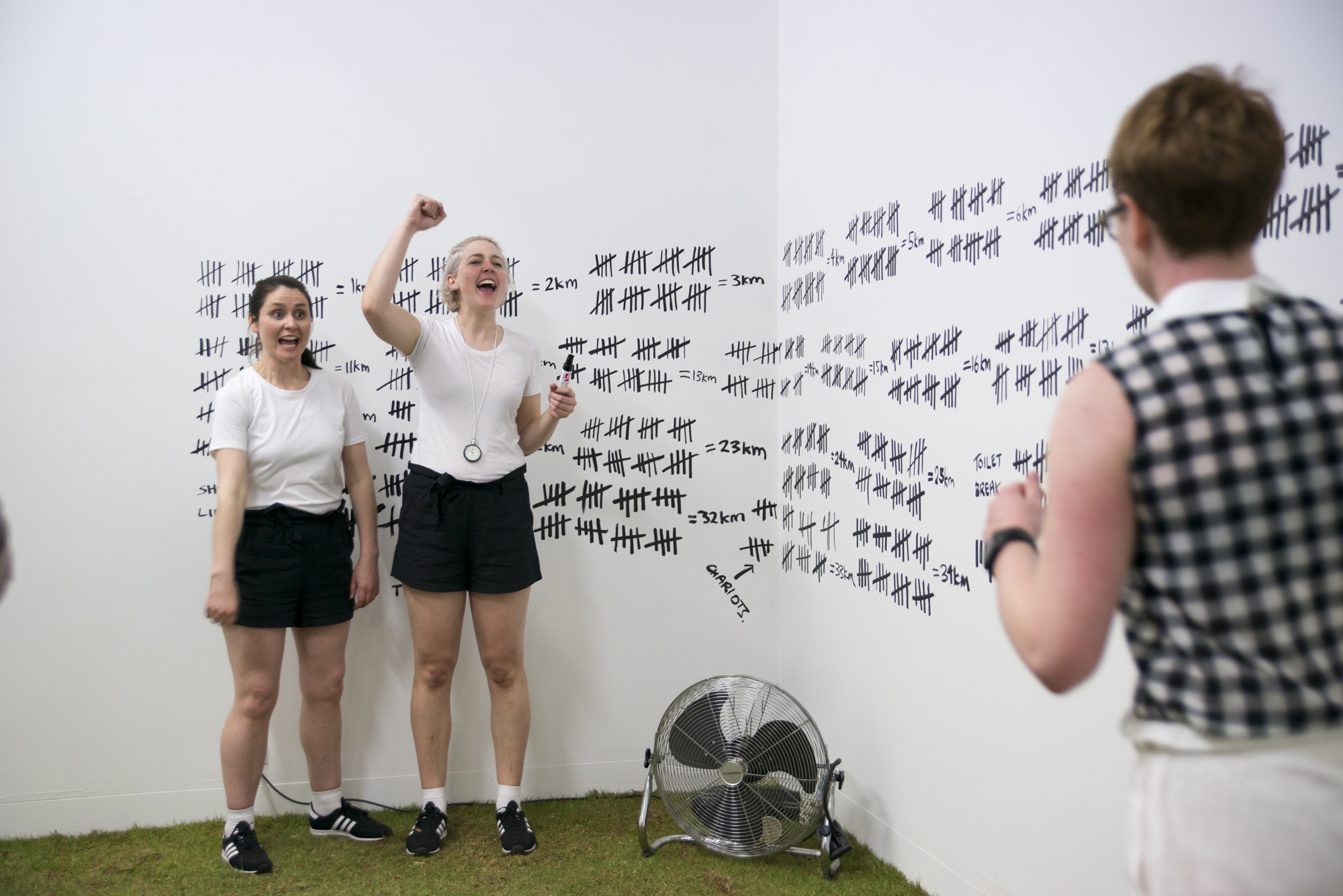
I am mostly influenced by local artists, whom I have come to meet and know through their practice. Artists I have recently been influenced by include: Mira Oosterweghel, who uses both her own body in performance, but also delegates performance to other artists; and theatremakers, THE RABBLE, whom I was very fortunate to spend 2016 with as Lead Artist Intern. Theatre for THE RABBLE is a conversation that sits somewhere between extreme pursuits of the body and mind, exquisite beauty, pain and comedic and political intelligence. Emma Valente of THE RABBLE has continued to act as mentor for my artistic practice into 2017, and is dramaturg for SQUASH!
Meg, you have participated in Adhocracy numerous times over the years, in different ways. Tell us about the Adhocracy experience from an artist’s point of view (participating artist and artist in the audience).
MW: In 2014 I took part in my first Adhocracy residency, Future Present, alongside 9 other SA artists under the guidance of Rosie Dennis of Urban Theatre Projects. At this point in time I was at a major crossroads in my career as a purely visual artist. I had become interested in interdisciplinary and collaborative art making, having only ever worked in solitude in a largely isolating manner. Exposure over a two-week period to the methods of artists largely unknown to me, allowed me to explore process and take risks in an environment where no idea was precious. I learnt how to make in a space where it was okay to be vulnerable, experimental and chuck things out when they’re just not working. It was during this residency that I first met and collaborated with performers and theatremakers, Ashton Malcolm and Josephine Were. Together, we continue to decipher and define a language of making that sits somewhere between live art, theatre and performative installation and have been prolifically generating works across all disciplines.
In 2016, I was able to take part in Adhocracy as part of a newly formed collective of artists: Hew Parham, Nick Bennett, Paulo Castro and Sascha Budimski, on Tension of Opposites. This was the first time all of the artists had worked together and the work was in its very initial stages of development. The platform of Adhocracy allowed us to test the viability of the team’s working relationship within a collaborative framework, and to devise material in a compressed (and somewhat intense) fashion. With access to multiple audiences and the ability to talk to the work and respond to critical feedback and discussion over the three days of presentation of the work in progress, was extremely beneficial to the team and the direction for the work leading into its next stage of development.
Adhocracy is also just a very excellent opportunity to observe and to chat. To see artists come from all over Australia to share their process, listen to early creative thoughts and engage in a national conversation, Waterside in Port Adelaide, is actually just a giant treat every year.
SJ, last time you were in Adelaide, you presented a new work Stone Tape Theory, as part of PADA’s Near & Far exhibition and the first Tarnanthi Festival of Contemporary Aboriginal and Torres Strait Islander Art. The work then went straight to SPILL in the UK. What is the experience of presenting your work in Australian and European contexts as a queer, Aboriginal artist?
SJ: The short answer goes like this: I am a bi-cultural, globalised, neo-colonial, late capitalist, Indigenous Diaporic, queer subject, and unpacking what that means is a big part of my practice and life. Just to widen the context: I come from a background of geographical and cultural dispossession: I was raised by a single Aboriginal mother and we moved around a lot. Just as she had done, as the offspring of itinerant workers, and as they had done as people who were dispossessed of their land. So, spatial liminality is second nature to me. I’ve never called a singular place home and I doubt I ever will. I’ve been on the move pretty constantly between Australia and Europe for the duration of my adult life and practice. My practice has grown in the in-between space in geographical, discursive, formal and cultural terms. Thresholds and crossroads are my place in the world, everything I make is generated from within these spaces.
A work like Stone Tape Theory (STT) travels more easily between contexts because it is speaking quite broadly. First and foremost, it’s a work about mental health and my specific struggle with complex trauma. It’s not a work which has what audiences might see as recognisably Indigenous or queer themes, despite the fact that it is made by a Queer Indigenous artist and my subjectivity has entirely shaped its realisation.
Whether or not a work, made by an Aboriginal artist, which is not explicitly relating to their Aborginality, is still an “Aboriginal Artwork” is like enquiring after the sound of one hand clapping…it’s a question I hope we are all bored of, by now.
One of the tricky things, of course is, once an artist is identified as Aboriginal, they are not allowed to be or make anything else. Queer artists often fall prey to the same pigeonholing, but to a different, and I would argue, significantly lesser extent. Aboriginal artists who choose to (*gasp*) occasionally make work about other things are often treated by the art public and occasionally by their peers as somewhat treacherous or suspicious- it’s just further evidence of our failure to fulfil the criteria of a white-centric standard of Indigenous “authenticity”. This just a part of a bigger, and much more complex, structure of systemic exclusion which seeks to sequester Aboriginal practice away from the main body of contemporary art. It’s just another manifestation of a colonial imperative to keep Aboriginal people and artists firmly in our place. It was a bold choice for TARNANTHI and PADA to jointly present Stone Tape Theory in the context of a major review of Indigenous practice, because the dominant perceptions of what that can be remain quite narrow in Australia. Next Wave made a similarly bold choice by programming Concerto No. 3 in BlakWave.
I’m thankful to the presenters I have worked with in this country who have shown this kind of guts, and it does take guts.
I presented STT at SPILL London within weeks of the Adelaide presentation. It was the second time I had been commissioned by SPILL, the first was Bone Library in 2015. Bone Library had received a thunderous reception at the previous SPILL so the pressure felt very high. I made the work, as I make all my work, entirely on my own.
I had been without a fixed address for about 9 months prior to the presentation, I didn’t have a studio, and I was managing what can only be described as a fully blown nervous breakdown, I was really held together by frayed sticky tape at that point. So to say the work was pretty raw is an understatement.
It went down well in London, though I am sure it confused and polarised some people. It was not an easy work. It required some investment of risk and discomfort from the audience. Some people literally left screaming: even I was terrified to be in there sometimes, the force of energy summoned by the work was immense and occasionally tipped into actual horror.
I have a long history of presenting and working in the UK, in particular. It was really in England that I first established my practice, after I moved there in 2006. The live art community, and specifically the community in Bristol where I was based, had a big part to play in growing me up artistically. Much of my practice, especially with regards to the works which focus on the broader terrain of colonial history, have been born out of my own cultural and political bi-location between England and Australia. England still feels wildly foreign to me at times but then, so does Australia.
That said, adapting Bone Library for an overseas audience was a nerve wracking experience. First of all, there are protocols and relationships that I have to carefully observe and manage in order to take the work off-country. There were a lot of ethical questions which I had to very rigourously engage before the work was ready to tour. That took about 6 months of extra work.
I did not expect the work to receive the rapturous reception that it did at SPILL, or subsequently at Venice International Performance Art Week. It was a really humbling experience, because I saw how deeply audiences from literally all over the world (there were delegations from every continent at Venice) were able to connect with it.
The English really surprised me, to be honest. UK audiences are known for their coolness, and I also did not expect them to so readily connect with the work, and to do so with such depth and sincerity. People were bawling their eyes out, like really really crying, when I read the Elder’s welcome handed the bones into their care. Bone custodians from everywhere regularly write to me to express their gratitude for the work, for the insight that it gave them and the chance they had to connect with some sense of intimacy and agency to a history which has been denied. It’s not just Aboriginal people who are denied our truth when history is suppressed. Settlers are also denied the opportunity to reckon with their own part in that history and to heal their own relationship to it as the descendants of perpetrators. Similarly, the work has yielded incredible, heartful dialogues between me and others whose cultures have been marked by similar traumas. This is part of the cultural labour that I aim to achieve with Bone Library, and many of my other works.
I dearly wish I could say I had had the same experience performing the work in Australia. But sadly the work has only been performed to scale in this country once in its 7 year life span, for five days in Melbourne in 2010. Likewise, Unsettling Suite, the body of works that Bone Library comes from, has also only been seen once in this country, at Performance Space in 2013. Elders and Aboriginal community have expressed their appreciation of the work, as have quite a few emerging Aboriginal artists who have personally expressed to me how influential Bone Library and the other works of the Unsettling Suite have been on their own practices. This is hugely rewarding and sustaining for me to know. I had wonderful audiences for the 2010 performance and I know that and, that said, I’ll repeat that the work has been produced to scale once, in its 7 year life span.
In the 7 years I’ve been performing it, Bone Library has received a total of about 600 words in coverage from the Australian arts press, and a good 200 of those were expended by a critic fixating on my fashion choices, hairstyle and “air of contemporary urban sophistication” which apparently undermined her own expectations of what an Aboriginal person looks like…this is not me having sour grapes, by the way!
I also have a lot of really, deeply wonderful and nourishing support here, and owe a tremendous amount to the people who have backed my practice fiercely. I’m just alluding, perhaps not so subtly, to some structural disadvantages that have affected me as an Indigenous queer experimental artist working in this country.
We also have a problem, in Australia, with devaluing our own artistic legacies. This is a very colonial problem. Institutionally, whole local performance histories have gone criminally under-recorded in favour of a focus on the European and American cannon. This shows up, for me and other artists, in peculiar ways. For instance, recently, I was made aware of a graduate show at a well-known art college in which a student had made a piece that directly plagiarised a work of mine. I’m not talking about an obscure piece, either, but a work which I have performed all over the world, at least once a year, for the last 12 years. If a student had made a piece that was, say, directly plagiarising the work of any of my European or American peers, I can’t imagine they would have gotten away with it. But “local” artists are fair game because we are fundamentally valued less. Art students know everything there is to know about Marina Abramovic but they’ve never heard of Jill Orr. And our cultural memory here is so alarmingly contracted.
People who are students now, even in cities with such rich local performance histories as Sydney, know everything about the 70’s in New York but nothing about the radical work that was being produced in the 90’s in their own town, by living artists who probably live around the corner from them. I find this confounding and deeply saddening.
All of these things have been very good reasons for me to put a lot of distance between myself and Australia, at times. Distance is also essential for me to gain perspective on the things that I want to talk about here, especially with regards to de-colonial discourse. It helps me to generate and clarify ideas. It’s hard to do that here, because the problems you want to address are inches from your face at all times.
Tell us about something you are currently obsessed with?
SJ: I’ve been too concerned with survival recently to have the time for many obsessions, sadly. Hopefully that will change. Other than that, I guess my thoughts are quite occupied by environmental calamity and existential collapse, and the looming specter of theocratic fascism.
Planting a medicinal herb garden while the world burns, basically.
I’m also trying to finish writing a couple of books. I’m heavily pre-occupied with re-grounding back in Australia after 9 years predominantly based in Europe – that is a shock to the system. I am obsessed by all the things that are fucked about Australia politically and continually strengthening my own agency and that of those around me to resist, agitate and transform this neo-liberal colonial white supremacist political cesspit we’re all trying to survive in. I’ve also been pretty obsessed with body-building and weightlifting for about a year now, lifting heavy shit keeps me sane.
MW: To be honest, I’m not great with obsessions. I don’t really have interesting ones. I do become engrossed with current projects and then ways of switching off from projects.
The problem is that my projects often require a huge change to my lifestyle in order to realise a project outcome. Right now, I would say that I’m obsessed with the game of squash and becoming quite good at it (I hope).
The counter obsession is watching mindless documentaries on Netflix such as Locked Up – a documentary that follows prisoners in penitentiaries in the U.S., but I always find a link between these mindless obsessions and the things I’m currently working on.
As independent artists what are the kinds of initiatives and programs that you want to see further support for in the future? What excites you in Australian arts?
SJN: Top of the wishlist? I would like to see independent artists become unionised, the same as any other industry. I would like to see an end, once and for all, to the cult of genius and the speculation economy. I would like to see more initiatives that increase the industrial organising power of artists and arts workers, because we are an extremely exploited workforce.
I would like to see more opportunities for artists to become politicised and organised around labour and class, because right now the arts is dominated by, and upholding, overwhelmingly bourgeois cultural values to our great collective detriment.
I would like to see more opportunities for rigorous training and development for younger artists, in particular, outside of institutional frameworks. I owe my own practice to the training and mentorship I received at PACT Centre for Emerging Artists in Sydney. The Impact Ensemble was an incredible and totally accessible program. I would love to see it returned to its former glory. I would love to see more initiatives like it. I would like to see them abundantly funded.
I would like to see more de-colonial pedagogy. I would like to see a decentralisation of power outside of major institutions. I would like to see more and more and more Indigenous led organisations and more Indigenous people in positions of power within the arts. I would like to see how this would change the landscape for the better. I would like to imagine a future where Indigenous artists and people are running our own show, and the real depth, complexity, diversity and strength of our contributions as innovators, artists and leaders was give then value it deserves.
MW: I have obviously greatly benefitted from my relationship with Vitalstatistix and programs such as Adhocracy that champion experimentation, interdisciplinary practice and the importance of diverse audiences for works in various stages of development. As a former co-director of an Artist Run Initiative (ARI), I also champion artists who create opportunities that bridge gaps for other artists.
I highly support initiatives that nurture artists in their early stages of practice and those that interrogate artistic processes. It’s okay to have a good cry or two during this process!
I defer to an earlier question about artistic community with regard to what excites me about Australian arts. I just think that within the independent scene there is an overwhelming amount of support between peers and it is these relationships that allow us to keep kicking goals (shameless sports reference) as artists struggling in a pretty grim environment right now, all the while managing to sustain important, relevant and exciting conversations surrounding topics of substance that continue to matter.
Vitalstatistix spoke with Adelaide-based independent artists Sasha Grbich and Jason Sweeney. Sasha is a visual artist, writer and lecturer; Jason is a singer-songwriter, composer and multidisciplinary artist. Both have long-term associations with Vitalstatistix and each is involved in our five-year climate change project Climate Century.
Climate Century asks artists to consider how will we commemorate and memorialise the climate century? The project includes a series of projects, commissions and events.
Join us on Sunday 17 July at Waterside for Climate Century – An Afternoon of Artist Talks.
V: Could you each tell us about your artistic practice?
Jason Sweeney: At the heart of everything, I make sound. Melancholy responses to the world. In recent times my focus has returned to song-writing with my band Jason & Silver Moon. But the past has seen me making live performance, online projects, films and installations. I work hard every day to make life and art the same thing. To practice quietness, to embrace melancholy, to live within my means, to give back to the planet in some way.
Sasha Grbich: I am interested in the ways places, things, communities or stories contribute to an artwork happening. My works are open to their local worlds. For example, I have worked with singers to find and record notes for and from fragile environments, made works that respond to the flickering of light in the windows of urban streets, pressed vinyls of uncomfortable silences and broadcast soundscapes from empty rooms, abandoned buildings and moving shopping carts. I am currently building a ‘wind sound effect machine’ in order to respond to gales in upcoming performance and video works. These are the kinds of absurd and poetic acts I undertake to reflect on how I exist within the places and communities I am part of.
V: You are both based in Adelaide and maintain solo studio practices. What are your thoughts on the opportunities available to mature, contemporary artists in South Australia – what are the benefits and disadvantages of working here?
SG: I go to work each day in my studio space at Fontanelle studio surrounded by wonderful artists and exciting half-formed things. I teach at the Adelaide Central School of Art and enjoy being amongst the vibrant art practices of my students and colleagues. My more personal communities also contribute to making my work. I collaborate with my brilliant partner Heidi Angove and try out new video ideas with my ever-patient sisters, friends and parents. I take great pleasure in these daily engagements within strong creative communities. Working with Vitalstatistix over the past five years has provided important, intense and rewording pockets of activity and openings to national and international art and performance practices. The benefits of working in Adelaide all stem from being part of close, collaborative and supportive industry and communities.
The disadvantages of working in South Australia can be illustrated through the example of recent Australia Council funding cuts. These upheavals have been debilitating to the small to medium sector in contemporary and experimental arts. In Adelaide my sector is small (although vibrant and exciting) – and it is very vulnerable.
JS: I’m an absolute advocate for Adelaide. It’s a place where you can still breathe clean air and make work without too much noise of cultural saturation.
In a world falling apart and a global population increasing beyond measure and pressurising the planet, I choose Adelaide as one of the remaining possible bastions of sustainable life, both in my day-to-day existence and in my work.
I need to be near nature all the time, so South Australia is a perfect place. I suppose it’s the ideal place for an introvert – and the internet connects me to all the people and things I need.
V: Sasha, as well as co-curating last year’s Climate Century exhibition, you made an artwork called Small Measures. Can you tell us about this work?
SG: ‘Stand in a place you feel to be vulnerable. Listen to the sounds happening. Now find a note, tune-in and hold it. Breathe. Hold a note again.’
This is the instruction I gave to volunteers from the Born on Monday choir when making Small Measures for Climate Century 2015. In some louder industrialised environments, the sounds sung became somewhat adversarial and lament-like. A sensitive registering of the small differences between places was played out in the variations between notes the choir members improvised. In the resulting video and sound installation the notes mixed unpredictably across the upper-floor of an old bank building. At once a love song and a lament, the work also held the feeling of ‘tuning up’ reminiscent of moments where a person and instrument (here a person and an environment) start a negotiation. In making the work I was driven by an image of sonography – the way ships tentatively feel their way along the ocean floor by bouncing sound off it.
V: Jason, can you tell us about Climate of Cruelty, a new commission from Vitals as part of the Climate Century commissioning process?
JS: Climate of Cruelty will develop as a song-cycle and live performance event working with writer Em Koenig and my band Jason & Silver Moon (with Zoë Barry and Jed Palmer) – as well as creating an online activist space, writing portal, and resource. It is a way to redress the balance for individual animals slaughtered at the hands of humans in environmentally-impacting commercial industries in Australia and globally.
In my own life, the time arrived when I needed to face the evidence of the history of cruelty against animals to literally feed our human desires; how the livestock industry exists because of our human need to consume animals; how such an industry has a major impact upon the planet, upon the environment, and upon biodiversity; and on the act of needless killing.
V: With climate change being the greatest challenge facing humans, other species, and the planet, there has been a burgeoning of artistic and cultural responses to this condition. Are there things to be mindful of when investigating climate change and the Anthropocene through art?
SG: I am excited by the potential of art to prompt new ways of feeling and thinking within this situation. A great example of this can be found in Sundari Carmody and Matthew Bradley’s collaborative work Winds of Increasing Magnitudes. During the Climate Century exhibition last year their huge semi-transparent silk flag (stripped of all the markers and signs that may suggest ownership or claiming of land) traced movements of air on sky. To visit the work, audiences trekked out to the windiest part of Port Adelaide where loose hair and scarves joined in the action of the flag. Standing in heightened awareness of the wind, people might remember growing up under the hole in the Ozone Layer, checking the UV index, and wondering at the air quality whilst inextricably breathing in. Experiencing Matt and Sundari’s work I was brought into new relation with memories and ideas while becoming sunburnt and windblown.
The ‘Anthropocene’ describes the current period of time in which human acts take on geological proportions. Like many artists, I understand my practice as part of ways of being in, and reflecting on, my world. It is no surprise then the condition of climate change has become a situation within which my own (and other’s) works act.
JS: In order to make responses about our planet as artists I truly believe there has to be equal response in one’s personal life. As humans making art about climate change, surely the only way to fully express an idea is to practice – fully – an investigation into the way one lives.
For me, I can’t make a work about animal cruelty and the adverse effects of the livestock industry on the environment, and then live a life that promotes cruelty: especially to animals. Climate of Cruelty is about being mindful that cruelty can often be silent or silenced or disguised as comfort, especially where the use, consumption, and abuse of animals is concerned.
I’m always confused when artists who say they are environmentalists are still contributing through excessive use of resources in their work, or are not working with recycled materials, or – dare I say – are not vegetarian or vegan. Artists, in so many respects, should be the voices to the dire situation our planet faces – we are, after all, part of the human impact that has led to the coming catastrophes. In a way, all that artists – and humans – should be concerned about now is our place on the planet and our own actions in contributing to climate change. It’s an emergency.
V: As artists working in the space of climate change, how do you grapple with feelings of melancholy and feelings of hopefulness?
JS: Once you’ve made the commitment to live a cruelty-free life, which includes being vegan, there are things you can never un-know. Sometimes I feel such urgency to communicate what I’ve learnt about animal suffering to other people, but then I watch them continue to consume animal products as if nothing were wrong.
My greatest share of melancholia is derived of human behaviour. When it comes to the dire impact of climate change as a result of human greed it seems impossible to not despair. This planet doesn’t need humans. We suck the earth dry. When humans disappear I am sure the earth will breathe a huge sigh of relief. The animals, plants and trees can finally get on with living, as they always have, in a sustainable way with the planet.
Knowing humans have created an industry that literally churns out animals for our desires, our plates, our bodies – creating an even greater impact upon our planet – how can I not exist in sadness?
Sometimes, when I look at the damage humans have inflicted upon the earth it renders me inarticulate, silent.
Hopefulness will come when I begin to observe those around me really beginning to embrace a cruelty-free, animal product-free life. Only then will I know an important change is starting to happen. In the meantime, I will keep my polite silence at the feeding table as I watch those around me continue to be sadly misinformed about the suffering of animals at the cost of our planet and our bodies.
SG: If there was no hope, I wouldn’t make work. I believe artwork always has radical potential to open new ways forward in any situation. I watch for these glimmering moments where art is part of the making of wild associations, and in them find great hope against the backdrop of a very difficult and depressing global condition.
V: You both have made multiple works that explore urban sound and quietness. Tell us a little bit about this area of interest.
JS: Quietness and silence is innate in me. Introversion and seeking solace has been with me since I was a child, in fact I never wanted to leave the womb! Now, I think my quietness has been worn down as I continue to observe the sadness and horrors of the world. Idle chatter is pointless. So it seems only natural in my later years my obsession with quiet seeking has found its way into my work.
My largest project, Stereopublic (Crowdsourcing the Quiet), asks members of the public around the world to use an app to contribute quiet spaces in their cities as a way to respond to the noise, din and anxiety of our urban environments. A participant can record audio of that space, and I gift back to them an original ambient composition. To date 65 cities around the globe are participating with almost 2000 quiet spaces found. It’s pretty inspiring. And, to reflect back on the idea of ‘hope’ above, it gives me hope there is a global community around me seeking the peaceful, seeking out spaces away from the din of industry and crowds and ‘vibrancy’. So I’m continuing this exploration in a more personal sense this year with something I call Quiet Ecology – which maps sonically, culturally, and environmentally the impact of noise on the planet and the real benefits of quiet preservation for our continued well-being.
SG: Heidi and I temporarily “borrowed” a shopping trolley for five Saturdays in a row in a shopping centre plaza in Noarlunga. I clanked about with a mad scientist set of wires and 3G dongles that let me stream online the intimate, sometimes harrowing and delightfully banal soundscapes and conversations I had with passers-by. Nothing was recorded. These sounds and conversations were for those who tuned in and for those who were there.
I am often led by sound, although I don’t describe myself as a sound artist. I love the immediacy of sound and the gentle touch of quiet. I like listening more than creating sound, and as such my works often make heightened situations for the act of listening or tuning-in to an occurrence or community.
V: You have each worked with Vitalstatistix before, on multiple projects in addition to Climate Century, such as our annual experimental art hothouse Adhocracy, and as commissioned artists for Cutaway, a three-year project completed in 2013. What value does these types of long-term relationships between artists and organisations hold? What do you see as Vitalstatistix’s place/role locally and nationally?
SG: My relationship with Vitalstatistix has been (and continues to be) intrinsic to my development as a professional artist.
For Adhocracy, Heidi and I chartered a boat, put an internet radio transmitter on it and took it out to the edge of the broadcast network. This was an act that sought failure, ‘dropouts’ and lost communications. Adhocracy provides a forum for experimentation, failure, and conversation. It is a place for audiences to come close to tentative and fascinating early stage projects. The program brings together experimental artists from many fields, and the conversations had over toasted sandwiches and between showings spark new trajectories.
There is a symbiosis that occurs when an organisation is fueled by, and fuels, the communities it participates in. Long-term community embedded projects like Cutaway and Climate Century allow time for meaningful collaborations to bear fruit.
In order to lead, you have to break new ground. Vitalstatistix is the only place in South Australia for audiences and artists to experience and make works that play with the expanding and increasingly blurred edges of performance and the visual arts. Vitals is a natural and national leader.
JS: My first real long-term connection to an organisation was with Doppio-Teatro/Para//elo between 1998-2004. This was such an important time of my life – and, in the history of contemporary art and experimental performance in SA, they were one of the more significant companies to exist. That involvement, particularly with Teresa Crea, was the best mentorship I could ever hope for. Teresa was really setting the stage for events like Adhocracy – unfortunately people just didn’t seem to get it or appreciate it at the time and that history, especially of Para//elo, isn’t acknowledged. SA needs to honour Teresa and how much she invested in young, experimental artists – particularly artists from diverse cultural backgrounds. Teresa taught me art, culture, and community are intrinsic, interconnected. She’s a legend.
And so my next longer connection has been with Vitalstatistix – a logical connection after so many years with Para//elo. Vitals is a company I’ve always loved as a feminist/queer space for performance and personally as a queer artist I saw much comradeship. My deeper connection from 2010 onwards has been so important to my artistic development – allowing me both an artistic and a curatorial platform in which to work. Vitals is the only company in SA dedicated to a national conversation around the delicate practice of emerging and experimental live art and performance.
V: How are you feeling about the future of the arts locally and nationally?
JS: We’re living amongst one of the world’s oldest living cultures and so I’m consciously aware I’m a queer, white, male existing in a place of deep spirituality, mystery and ancient Indigenous creativity. Art has always been here and will continue way beyond my years. Art exists in nature, in people, in the everyday, in the spiritual. The inheritance of this slightly icky European model of contemporary art in Australia has always made me uncomfortable so I struggle to talk about that, but I’ll try.
I’ve always felt it is within the power of the culture itself to sustain and drive forward its future. Like most of our society, we rely so heavily on government bodies to shape and make our lives. Lately, the destabilising funding cuts have made me think about this addictive feeding tray that arts funding has become – and I’ve certainly had my fair share and that’s amazing, I’m very lucky. I am committed to being an artist and making work as a response to the world no matter what – I just happen to be in a country where the option of seeking government funds is possible. Yet, I am worried artists and the art world’s reliance on funding may impact our future. It’s like we align getting a grant with making work or having status – or if a curator selects you then you must be better than those who were not chosen. Sure, it’s great when it happens, when you get the ‘yes’ emails – but would I still make a work if there was no funds or project selections?
Perhaps it’s analogous to the way we consume food. We rely on a supermarket or grocer to provide for us – and yet, you eat a pumpkin, save its seeds, put it in the ground, and in a few months you’ll start to see a new pumpkin grow and you’ve got dinner – and it cost nothing but the time it took and diligence you had to plant a seed in the earth.
At the end of the day we need to eat, so we need sustenance – and it can come for free. In these times of global crisis, the future holds so much for some real creative gardening to take place – literally and figuratively. Let’s get back to the earth and stop worrying about money all the time. Money and the desire for it are killing our planet. It’s up to artists to lead the charge. To create work, live a frugal life, and respect nature – give back to it rather than tear away at the planet’s resources. The death of the arts (in that ‘industry’ sense) will be an all-consuming anxiety around ambition, competition, and the bloody fight to the last dollar or status position. We need to be conscious the arts don’t start to mirror the corporatised and patriarchal systems most of us are fighting to escape from.
SG: Thinking to the future, I feel depressed.
Even as I begin to answer this question I find myself winding up into a rant-like answer about the importance of arms-length funding and the potential of a well-funded industry. But it has all been said, and seems to be unheard by those who need to act.
This isn’t a reason to give up on hope or activism.
[cycloneslider id=”jason-sweeney-and-sasha-grbich”]
